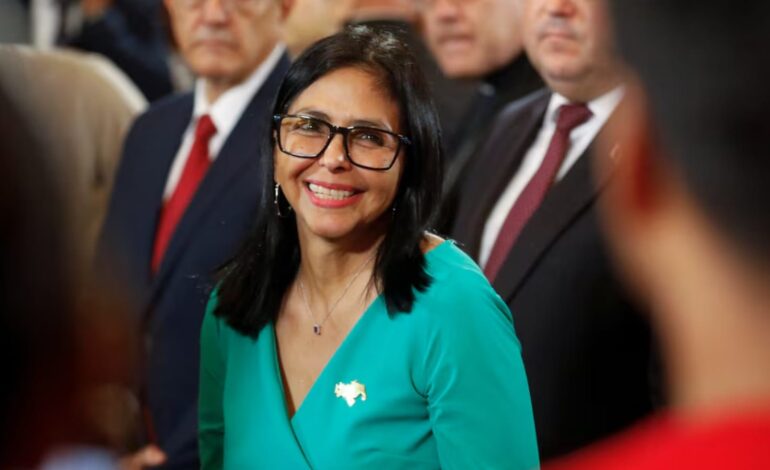

Venezuela has entered one of the most uncertain and consequential phases in its modern political history following the swearing-in of Delcy Rodríguez as the country’s interim president. Her appointment comes in the aftermath of the dramatic removal and arrest of former leader Nicolás Maduro, an event that has reverberated far beyond the nation’s borders and intensified global scrutiny of Venezuela’s future.
Rodríguez’s sudden elevation to the highest office marks a seismic shift in Venezuela’s leadership at a time when the country is already grappling with deep economic distress, political polarisation, and strained international relations. While authorities have framed her appointment as a constitutional step designed to preserve stability and continuity, reactions inside Venezuela and across the international community remain sharply divided.
This article examines who Delcy Rodríguez is, how she came to power, what her interim presidency means for Venezuela’s political and economic trajectory, and how regional and global actors are responding to this pivotal moment.
A Historic and Highly Tense Swearing-In Ceremony
Delcy Rodríguez was sworn in during a special session of Venezuela’s National Assembly in Caracas, held under tight security amid heightened political tension. The ceremony was conducted swiftly, reflecting concerns over public unrest and the fragile state of national governance following the arrest of Nicolás Maduro.
Government officials described the swearing-in as both constitutional and necessary, emphasising that the priority was to ensure the uninterrupted functioning of state institutions. According to official statements, Rodríguez’s interim role is intended to prevent a power vacuum while Venezuela navigates one of the most volatile transitions in its political history.
Rodríguez took the oath of office pledging to protect national stability, maintain public order, and safeguard government institutions. She stressed that her leadership would focus on continuity rather than radical transformation, though political analysts widely agree that her actions over the coming months could define Venezuela’s direction for years to come.
The Fall of Nicolás Maduro and Its Political Impact
The removal and arrest of Nicolás Maduro has fundamentally altered Venezuela’s political landscape. After more than a decade in power, Maduro’s leadership came to an abrupt end, closing a long chapter of political dominance rooted in the socialist system established under Hugo Chávez.
Maduro had long faced international accusations ranging from corruption and human rights abuses to economic mismanagement—allegations he consistently denied. His supporters argue that his removal represents foreign interference in Venezuela’s sovereignty, while critics see it as the inevitable outcome of years of political repression and economic decline.
Regardless of political perspective, Maduro’s arrest created an immediate leadership void. The National Assembly moved quickly to appoint Delcy Rodríguez as interim president, framing the decision as a stabilising measure to prevent institutional collapse and widespread disorder.
Who Is Delcy Rodríguez
Delcy Rodríguez is one of the most powerful and recognisable figures in Venezuela’s political system. With a career spanning more than two decades, she has occupied some of the most influential positions in government, including vice president, foreign minister, and oil minister.
Her political rise is closely linked to the socialist movement that has governed Venezuela since the Chávez era. As foreign minister, Rodríguez became a prominent international voice for Venezuela, often confronting Western governments and defending state policies at global forums.
Supporters describe her as experienced, disciplined, and capable of managing crisis-level governance. Critics, however, argue that her deep ties to the previous administration mean that meaningful political reform is unlikely under her leadership.
Why Rodríguez Was Chosen as Interim President
Rodríguez’s selection was widely seen as a strategic decision rather than a surprise. As vice president and a long-standing insider, she was viewed as someone capable of commanding loyalty from critical institutions, including the military, security forces, and state bureaucracy.
In moments of political crisis, governments often turn to trusted insiders rather than external figures. Rodríguez’s familiarity with state operations and her strong connections within the ruling establishment positioned her as a natural choice for interim leadership.
Her appointment also signals that the existing power structure intends to manage the transition internally, rather than opening the door to immediate opposition leadership or internationally mediated political change.
Domestic Reactions Inside Venezuela
Public reaction within Venezuela has been deeply polarised.
Supporters of the government welcomed Rodríguez’s swearing-in, arguing that continuity and order are essential during a period of uncertainty. State-aligned media portrayed the transition as orderly and lawful, highlighting her experience and leadership credentials.
Opposition groups, however, rejected the move outright. Many opposition leaders argue that Rodríguez represents the same political system that presided over years of economic collapse, hyperinflation, and international isolation. Small but visible protests have taken place in parts of Caracas and other urban centres, with demonstrators calling for free elections, international monitoring, and structural reform.
For many ordinary Venezuelans, political developments are viewed through the lens of daily survival. After years of instability, concerns about food access, healthcare, employment, and basic services often outweigh ideological debates about leadership transitions.
International Response and Global Scrutiny
The international reaction to Rodríguez’s interim presidency has been mixed and cautious.
Several governments have adopted a wait-and-see approach, calling for calm, dialogue, and respect for democratic processes. Others have openly questioned the legitimacy of the transition, citing Rodríguez’s close association with the previous administration.
The United States has stated that any future engagement with Venezuela will depend on concrete steps toward democratic elections, institutional reform, and political inclusivity. European and Latin American countries have echoed similar concerns, urging transparency and a clear roadmap for political transition.
Global human rights organisations and international observers continue to monitor developments closely, warning that the interim period could either open space for reform or further entrench existing power structures.
Economic Challenges Facing the Interim Government
Venezuela’s economic crisis remains one of the most severe in the world. Years of sanctions, declining oil production, infrastructure deterioration, and policy mismanagement have left the economy fragile and heavily dependent on oil revenues.
As interim president, Rodríguez inherits an economy marked by inflation, unemployment, and shortages of basic goods. Reviving the oil sector is widely seen as essential for any economic recovery, but sanctions and technical limitations continue to constrain production and exports.
Analysts suggest that Rodríguez may pursue limited engagement with international partners in an attempt to ease economic pressure. However, her political background and the current geopolitical climate make sweeping policy changes uncertain.
The Role of the Military and Security Forces
One of the most critical factors shaping Rodríguez’s short-term stability is the stance of Venezuela’s military. Historically, the armed forces have played a decisive role in maintaining or destabilising political leadership.
So far, military leaders have publicly expressed support for the interim presidency, helping prevent immediate unrest. Political analysts note that this backing is essential for Rodríguez to maintain control during the transition.
Long-term stability, however, will depend on whether the military remains unified and whether political tensions escalate into broader social unrest.
Is This Truly an Interim Presidency
Despite holding the title of interim president, questions remain over how temporary Rodríguez’s leadership will be. Venezuela’s political history includes multiple examples of interim arrangements extending far beyond their original mandates.
Opposition groups and international actors are pressing for a clear and credible election timeline. Rodríguez has so far avoided committing to specific dates. Instead emphasising national stability and dialogue.
This lack of clarity has fuelled scepticism over whether the transition represents genuine political change or simply a reconfiguration of existing power.
What Comes Next for Venezuela
Venezuela now stands at a critical crossroads. Rodríguez’s leadership could either create space for gradual reform. International re-engagement or deepen existing divisions and prolong political stagnation.
Key developments to watch include:
-
Signals regarding future elections
-
The government’s approach to political dialogue
-
Relations with the United States and regional partners
-
Economic policy decisions and oil sector reforms
-
Public response and levels of civil unrest
The coming months will be decisive in shaping Venezuela’s political and economic future.
Conclusion
The swearing-in of Delcy Rodríguez as Venezuela’s interim president marks a turning point in the nation’s modern history. Coming in the wake of Nicolás Maduro’s dramatic removal, her appointment has reshaped the political landscape. Placed Venezuela under intense international scrutiny.
While presented as a temporary measure to ensure stability, Rodríguez’s leadership raises fundamental questions about legitimacy, democracy, and long-term governance. With deep economic challenges, divided public opinion, and uncertain international support, Venezuela’s path forward remains unclear.
What is certain is that the decisions taken during this interim period will have lasting consequences for the country. And its people—shaping whether Venezuela moves toward reconciliation and reform.