
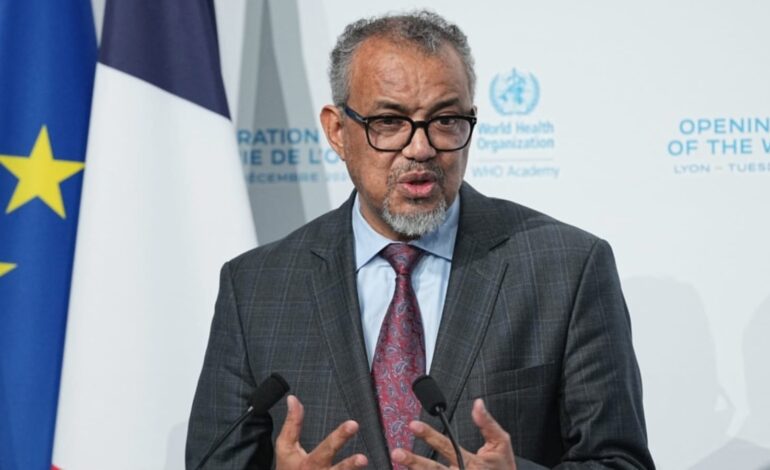

The Director-General of the World Health Organization (WHO) has issued a stark warning that the United States’ withdrawal from the organisation will weaken global health security and make both the US and the world less safe. Dr Tedros Adhanom Ghebreyesus cautioned that the decision undermines international cooperation, reduces preparedness for disease outbreaks, and weakens the global framework designed to prevent and manage future pandemics.
Speaking from Geneva, where the WHO is headquartered, Dr Tedros urged renewed cooperation at a time when global health threats are becoming more frequent, complex, and interconnected. His remarks come as the US withdrawal formally takes effect following the completion of a one-year notice period after a 2025 executive order.


A Warning With Global Implications
Dr Tedros stated that no country—regardless of its wealth, scientific capacity, or healthcare infrastructure—can effectively confront modern health threats alone. He emphasised that global cooperation through multilateral institutions such as the WHO is essential to detect outbreaks early, share information transparently, and coordinate rapid responses.
According to the WHO chief, the US decision risks:
-
Weakening global disease surveillance systems
-
Fragmenting international response mechanisms
-
Slowing coordinated action during health emergencies
-
Increasing vulnerability to pandemics and cross-border outbreaks
“These challenges do not respect borders,” Dr Tedros said, stressing that shared action and solidarity remain the foundation of global health security.
What the WHO Director-General Said
Addressing journalists and member states, Dr Tedros said the US withdrawal would diminish the world’s collective ability to respond effectively to health threats, including emerging infectious diseases and antimicrobial resistance.
He pointed to past global responses coordinated through the WHO, including outbreaks of Ebola, polio, and COVID-19, noting that cooperation enabled faster data sharing, joint research efforts, and coordinated emergency responses.
“Money can be adjusted,” he remarked, responding to arguments that financial considerations justified the withdrawal. “But the need for cooperation cannot be replaced.”
Background: How the US Withdrawal Unfolded
The withdrawal process began after an executive order signed by the US administration in early 2025 directed the country to exit the WHO. Under WHO and UN procedures, member states must provide formal notice and observe a one-year waiting period before withdrawal becomes effective.
With that period now concluded, the US has officially exited the organisation—marking one of the most significant shifts in American engagement with international health governance in decades.
The move comes amid:
-
Ongoing post-pandemic recovery
-
Rising concerns over future zoonotic diseases
-
Increasing frequency of global health emergencies
Why WHO Membership Matters
The World Health Organization plays a central role in coordinating global public health efforts, particularly in areas where unilateral action is ineffective.
Core Functions of the WHO
The WHO is responsible for:
-
Global disease surveillance and early warning systems
-
Coordinating emergency responses to outbreaks
-
Issuing technical guidance and health standards
-
Supporting weaker health systems through capacity building
-
Managing international health regulations
These functions help ensure that outbreaks are identified and addressed before escalating into global crises.
Impact on Global Disease Surveillance
Public health experts warn that reduced engagement by major economies could create gaps in disease surveillance and information sharing. Many low- and middle-income countries rely heavily on WHO coordination for:
-
Early detection of outbreaks
-
Laboratory support and data verification
-
Rapid technical assistance
Without strong participation from all major nations, these systems risk becoming fragmented, slower, and less effective.
Concerns Over Pandemic Preparedness
The WHO chief highlighted that pandemic preparedness depends on trust, transparency, and collaboration. Fragmentation of global health governance could:
-
Delay outbreak reporting
-
Slow vaccine and treatment development
-
Reduce access to shared scientific data
In an interconnected world, delays of even days or weeks can significantly worsen the spread of infectious diseases.
Legal and Financial Questions Surrounding the Exit
Although the WHO constitution does not explicitly outline a withdrawal clause, it allows member states to leave under specific conditions. Despite the formal exit, questions remain about whether the United States has fulfilled all its financial obligations, including assessed contributions for the current fiscal year.
WHO officials have warned that funding shortfalls could disrupt programmes focused on:
-
Immunisation
-
Maternal and child health
-
Emergency response capacity
-
Disease eradication initiatives
Global Reactions and Diplomatic Context
The US withdrawal has prompted reactions from governments and international leaders worldwide. Several countries have reaffirmed their commitment to multilateral health cooperation, emphasising the importance of global institutions in addressing shared risks.
António Guterres, Secretary-General of the United Nations, has previously expressed regret over decisions by countries to disengage from UN agencies, warning that global challenges require collective solutions rather than unilateral action.
The development also comes amid broader debates about:
-
The future of global governance
-
The role of international institutions
-
The balance between national sovereignty and multilateral cooperation
Implications for the United States
Experts note that the withdrawal could also have domestic consequences for the US. Reduced engagement with the WHO may:
-
Limit access to global surveillance data
-
Reduce influence over international health standards
-
Complicate coordination during future outbreaks
Public health specialists argue that participation in global health systems enhances—not weakens—national security by providing early warning and shared resources.
What Comes Next for Global Health Cooperation
Despite the withdrawal, WHO leadership continues to call for dialogue and renewed cooperation. Global health experts emphasise the need to:
-
Strengthen international data-sharing mechanisms
-
Reinforce early warning systems
-
Maintain preparedness for emerging health threats
There are also calls for reforms to ensure the WHO remains resilient, transparent, and responsive—while retaining broad international support.
Risk of Fragmentation in Global Health Governance
Analysts warn that the withdrawal could encourage other nations to reconsider their engagement with international health institutions, potentially leading to fragmented global responses.
Such fragmentation could:
-
Reduce efficiency in emergency response
-
Increase duplication of efforts
-
Leave vulnerable populations exposed
Maintaining cohesive global health governance is widely seen as essential to managing future risks.
The Broader Global Health Landscape
The world faces a growing list of health challenges, including:
-
Emerging infectious diseases
-
Climate-related health risks
-
Antimicrobial resistance
-
Inequalities in healthcare access
Addressing these issues requires sustained cooperation across borders, disciplines, and institutions.
Conclusion: A Warning for a Connected World
The WHO Director-General’s warning that the US withdrawal weakens global health security underscores the interdependent nature of modern public health. In a world where diseases travel rapidly across borders, multilateral cooperation remains one of the most effective tools for prevention, preparedness, and response.
As nations confront ongoing and emerging health challenges, many experts argue that engagement with global institutions like the WHO is not a matter of diplomacy alone—but a cornerstone of collective safety and resilience.





1 Comment
[…] strain on US diplomatic […]
Comments are closed.