UAE President Holds Talks with RAK Leadership
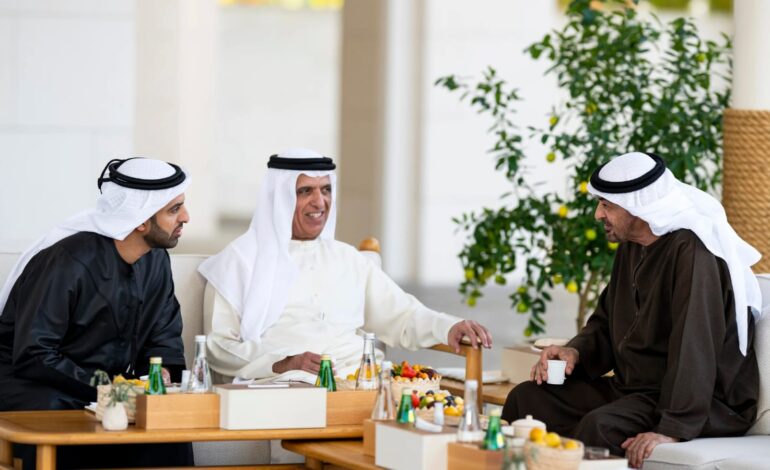

The President of the United Arab Emirates recently hosted His Highness Sheikh Saud bin Saqr Al Qasimi, Ruler of Ras Al Khaimah, along with the Crown Prince, Sheikh Mohammed bin Saud bin Saqr Al Qasimi, during a high-level leadership meeting in Abu Dhabi. The high-profile engagement underscored the strong bonds between the UAE’s federal leadership and the emirate of Ras Al Khaimah (RAK), with discussions centred on accelerating national development, strengthening economic cooperation and aligning strategic priorities with the UAE’s long-term vision.
The meeting was widely viewed by officials as a powerful reaffirmation of unity within the UAE’s governance framework. It highlighted the country’s collaborative leadership model one that promotes coordinated action across economic, social, cultural and governance sectors to ensure sustainable national progress
Strengthening UAE Federal–Emirate Relations
The UAE’s federal system has long been recognised for its emphasis on cooperation between the federal government and the seven emirates. Regular leadership consultations play a vital role in maintaining policy alignment and ensuring that development strategies benefit the entire nation.
This latest meeting between the UAE President and Ras Al Khaimah’s leadership reflects that tradition of close coordination. It demonstrates how the country’s top leadership continues to work collectively to address emerging opportunities and challenges in an increasingly dynamic regional and global environment.
Officials noted that the discussions reinforced the UAE’s commitment to unified national planning, a key factor behind the country’s economic resilience and rapid development over the past decades.
Purpose of the High-Level Meeting
At the heart of the Abu Dhabi talks was a shared determination to deepen cooperation across multiple priority sectors. The leadership discussions reflected mutual commitments to:
-
Strengthening federal–emirate coordination
-
Supporting economic diversification and investment growth
-
Advancing infrastructure and social development projects
-
Encouraging innovation and future-focused governance
-
Enhancing community wellbeing and quality of life
The meeting highlighted how Ras Al Khaimah continues to play an increasingly important role in supporting the UAE’s broader national ambitions, particularly in tourism, manufacturing, logistics and investment attraction.
Unified Vision for National Development
A central theme of the discussions was the UAE leadership’s shared vision for long-term, sustainable growth. Both federal and emirate leaders emphasised that continued cooperation is essential to maintaining the country’s strong development trajectory.
The UAE has positioned innovation, sustainability and global competitiveness as core pillars of its national strategy. During the meeting, leaders reviewed how Ras Al Khaimah’s ongoing initiatives including investment promotion, tourism expansion and infrastructure development align with these national priorities.
Ras Al Khaimah has in recent years emerged as one of the UAE’s fastest-growing emirates, attracting significant attention from international investors and tourism stakeholders. Its leadership’s engagement with federal authorities ensures that local growth strategies remain closely integrated with national planning.
Economic and Investment Cooperation Takes Centre Stage
One of the most significant areas of discussion was economic collaboration and investment expansion. The UAE continues to prioritise diversification beyond hydrocarbons, and Ras Al Khaimah has become an important contributor to this agenda.
Key economic priorities discussed included:
-
Expanding cross-emirate investment partnerships
-
Supporting business innovation and entrepreneurship
-
Enhancing the competitiveness of key sectors
-
Encouraging foreign direct investment (FDI)
-
Strengthening public-private partnerships
Ras Al Khaimah’s growing reputation as an investment destination particularly in manufacturing, tourism and real estate was recognised as an asset to the UAE’s broader economic ecosystem.
Officials indicated that deeper coordination between federal entities and emirate-level authorities could unlock new growth opportunities and improve the ease of doing business across the country.
Focus on Sustainable Infrastructure and Smart Development
Infrastructure development remains a cornerstone of the UAE’s long-term strategy, and it featured prominently in the leadership talks. Both sides reaffirmed their commitment to building sustainable, smart and future-ready infrastructure that supports economic expansion while protecting environmental resources.
Priority areas included:
-
Smart city initiatives
-
Sustainable urban planning
-
Transport and logistics enhancement
-
Energy efficiency and green development
-
Community infrastructure upgrades
Ras Al Khaimah has been investing heavily in infrastructure to support its tourism ambitions and industrial growth. Aligning these projects with federal sustainability frameworks helps ensure consistency with the UAE’s net-zero and climate goals.
Youth Empowerment and Education Initiatives
Another major pillar of the meeting was youth development — a cornerstone of the UAE’s future strategy. Leaders emphasised that investing in young people is essential for maintaining the country’s global competitiveness.
Discussions focused on:
-
Enhancing education quality across emirates
-
Expanding skills development programmes
-
Preparing youth for future job markets
-
Supporting innovation and entrepreneurship among young Emiratis
-
Strengthening research and knowledge-based sectors
The UAE leadership has consistently highlighted human capital as one of the nation’s most valuable assets. Ras Al Khaimah’s education and workforce initiatives were reviewed in the context of broader federal plans aimed at building a knowledge-driven economy.
Preserving Culture and National Identity
Beyond economic and infrastructure priorities, the meeting also addressed cultural cooperation and the preservation of national identity — key themes in the UAE’s development model.
Leaders reaffirmed their shared commitment to:
-
Protecting Emirati heritage and traditions
-
Promoting cultural exchange across emirates
-
Supporting creative industries
-
Strengthening national unity and social cohesion
Ras Al Khaimah’s rich historical heritage and growing cultural tourism sector were recognised as important contributors to the UAE’s broader cultural landscape.
Officials stressed that balancing rapid modernisation with heritage preservation remains a defining feature of the UAE’s development approach.
Ras Al Khaimah’s Expanding Role in the UAE Economy
Over the past decade, Ras Al Khaimah has significantly strengthened its economic profile. The emirate has become known for its diversified growth strategy, which includes:
-
Tourism and hospitality expansion
-
Manufacturing and industrial development
-
Logistics and trade connectivity
-
Real estate and infrastructure investment
-
Adventure and eco-tourism initiatives
The leadership dialogue in Abu Dhabi highlighted how these sectors complement the UAE’s national diversification strategy.
RAK’s proactive investment policies and business-friendly environment have helped attract global companies, reinforcing the emirate’s role as a key contributor to the federation’s economic momentum.
Leadership Statements Emphasise Unity
During the meeting, the UAE President reaffirmed the importance of unity, shared values and collective ambition in driving national success. He praised Ras Al Khaimah’s contributions to the country’s socio-economic progress and noted that strong cooperation among emirates enhances resilience and expands opportunities for citizens and residents.
The Ruler of Ras Al Khaimah, in turn, expressed appreciation for the continued support of the federal leadership. He reiterated the emirate’s commitment to national priorities, particularly in areas that promote innovation, education, investment and inclusive growth.
Observers noted that such high-level exchanges play a crucial role in maintaining the UAE’s reputation for political stability and coordinated governance.
Potential Economic and Social Impact
Strategic meetings at the highest leadership level often translate into tangible policy momentum and project acceleration. Analysts suggest that outcomes from this engagement could include:
-
Increased investment flows into priority sectors
-
Faster rollout of infrastructure projects
-
Expansion of public-private partnerships
-
Growth in tourism and trade activity
-
Enhanced employment opportunities
-
Improved quality of life for residents
These potential impacts align closely with the UAE’s broader economic vision, which seeks to balance rapid growth with sustainability and long-term competitiveness.
UAE’s Long-Term Strategic Outlook
The meeting comes at a time when the UAE is intensifying efforts to strengthen its position as a global hub for business, tourism, technology and innovation. Federal-emirate coordination remains essential to achieving these ambitions.
Key national priorities currently shaping policy include:
-
Economic diversification and resilience
-
Digital transformation and AI adoption
-
Climate action and sustainability
-
Talent development and knowledge economy growth
-
Global trade and investment expansion
By aligning Ras Al Khaimah’s development plans with these national objectives, the UAE leadership aims to ensure balanced growth across all emirates.
Why Federal Coordination Matters
The UAE’s governance model is often cited internationally as a successful example of cooperative federalism. Regular leadership meetings help:
-
Maintain policy coherence
-
Avoid duplication of efforts
-
Accelerate project implementation
-
Share best practices across emirates
-
Strengthen national unity
The Abu Dhabi meeting reinforced how this model continues to evolve in response to new economic and geopolitical realities.
Outlook: Continued Momentum Expected
Experts expect continued high-level engagement between federal and emirate leaders as the UAE pushes forward with its ambitious development agenda.
Ras Al Khaimah, in particular, is likely to remain a key focus area due to its:
-
Rapid tourism growth
-
Expanding industrial base
-
Strategic geographic position
-
Increasing investor interest
-
Strong infrastructure pipeline
Closer coordination with federal authorities could further accelerate the emirate’s upward trajectory.
Conclusion
The recent meeting between the UAE President, the Ruler of Ras Al Khaimah and the Crown Prince marks another important step in strengthening national cohesion and strategic cooperation. The discussions reflected a shared commitment to advancing economic diversification, sustainable development and innovation-driven growth across the Emirates.
As the UAE continues its ambitious journey toward global competitiveness and future readiness, such high-level engagements remain essential. They not only reinforce political unity but also help translate national vision into concrete policies, investments and community outcomes.
The dialogue in Abu Dhabi highlights the enduring strength of the UAE’s collaborative leadership model — one designed to deliver prosperity, stability and opportunity for citizens, residents, investors and partners across the federation.