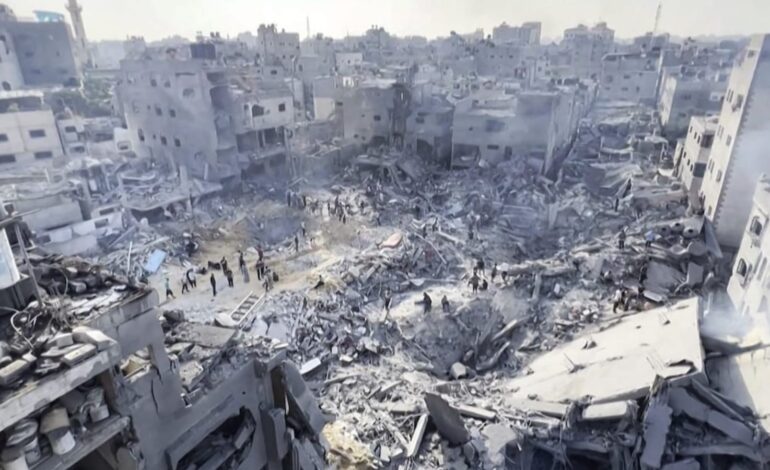

The United Arab Emirates has reaffirmed its strong commitment to supporting civilians in Gaza, with senior diplomat Dr Anwar Gargash stating that Abu Dhabi will actively use its international relationships to push for tangible humanitarian improvements on the ground.
Speaking at the Munich Security Conference, the diplomatic adviser to the UAE President stressed that urgent humanitarian relief in Gaza cannot wait for long-term political settlements. His remarks highlight the UAE’s expanding diplomatic role in regional mediation and humanitarian coordination at a time when the Gaza crisis continues to demand immediate global attention.
The UAE’s approach reflects a pragmatic strategy: prioritise immediate civilian relief while continuing to support broader diplomatic efforts aimed at long-term regional stability.
UAE Prioritises Immediate Humanitarian Relief in Gaza
Dr Gargash made it clear that the UAE’s top priority is improving daily life for civilians in Gaza rather than waiting solely for a final political agreement.
He emphasised that the focus must remain on real, measurable improvements in safety, security and livelihoods for people in the enclave. While acknowledging that a long-term political framework — including a two-state solution — remains important, he warned that Gaza’s humanitarian needs are too urgent to be delayed by complex diplomatic timelines.
Key Elements of the UAE’s Immediate Focus
-
Delivering urgent humanitarian aid
-
Improving access to essential services
-
Supporting civilian protection efforts
-
Enhancing food, medical and shelter support
-
Coordinating with international partners
This position reflects a dual-track strategy that separates emergency humanitarian action from longer-term political negotiations.
Analysts say this pragmatic approach allows the UAE to contribute meaningfully in the short term while still supporting diplomatic pathways toward a broader peace framework.
Leveraging Diplomatic Ties to Influence Outcomes
One of the most significant aspects of Dr Gargash’s remarks was the UAE’s intention to actively use its diplomatic relationships to support progress in Gaza.
He noted that Abu Dhabi will leverage its international ties — including its channels with Israel — to help decision-makers better understand the humanitarian realities on the ground.
What This Signals
-
A behind-the-scenes diplomatic role
-
Continued engagement with multiple stakeholders
-
Use of political access to facilitate aid
-
Efforts to influence practical outcomes
-
Positioning as a regional bridge-builder
Observers say the UAE’s ability to maintain dialogue with diverse parties gives it a unique role in a highly sensitive conflict environment.
Since normalising relations with Israel in 2020, the UAE has gained diplomatic access that could help support humanitarian coordination and de-escalation efforts.
UAE Rules Out Joining an International Security Force
Dr Gargash also clarified the UAE’s position on proposals for international security arrangements in Gaza.
He confirmed that the UAE does not plan to participate in any international security force operating in the territory. However, he stressed that the country will remain deeply engaged through other channels, particularly humanitarian assistance and diplomatic facilitation.
Why This Distinction Matters
-
Signals preference for humanitarian leadership
-
Avoids direct military involvement
-
Maintains neutral facilitator role
-
Reduces risk of escalation
-
Focuses resources on civilian relief
This stance underscores the UAE’s strategy of contributing to stability primarily through aid, diplomacy and coordination rather than security deployment.
Humanitarian Aid Remains Central to UAE Strategy
The UAE has already emerged as one of the largest humanitarian contributors to Gaza. According to Dr Gargash, the country accounted for approximately 45 percent of total aid delivered to Gaza over the past two years.
This substantial contribution highlights Abu Dhabi’s growing humanitarian footprint in the Palestinian territories.
UAE Aid Efforts Have Focused On:
-
Emergency food supplies
-
Medical assistance
-
Field hospitals and healthcare support
-
Shelter and relief materials
-
Logistics and humanitarian airlifts
Officials indicated that assistance will continue and could expand further, particularly if stronger transparency mechanisms are implemented for how funds are managed and distributed.
Call for Greater Transparency in Gaza Funding
A notable component of the UAE’s message was the emphasis on governance and accountability in humanitarian funding.
Dr Gargash stressed that the clearer and more transparent the system for managing Gaza funds becomes, the more willing the UAE and other donors will be to increase support.
Why Transparency Matters
-
Builds donor confidence
-
Ensures aid reaches civilians
-
Reduces risk of diversion
-
Improves coordination among agencies
-
Enables larger future funding commitments
This reflects growing international focus on aid accountability and financial oversight in complex humanitarian environments.
Analysts believe future reconstruction funding for Gaza could increasingly depend on robust monitoring frameworks.
Balancing Short-Term Relief With Long-Term Peace
During his Munich remarks, Dr Gargash acknowledged that any durable solution to the Gaza crisis must eventually include a political framework.
He referenced the importance of:
-
Avoiding irreversible actions in the West Bank
-
Keeping the two-state solution viable
-
Maintaining momentum toward long-term stability
However, he repeatedly emphasised that humanitarian action cannot be postponed while political negotiations continue.
The UAE’s Dual-Track Approach
-
Immediate humanitarian relief
-
Continued diplomatic engagement
-
Support for long-term political solutions
-
Focus on practical outcomes
-
Regional de-escalation efforts
This balanced strategy mirrors the broader Gulf diplomatic posture, which seeks to combine relief, reconstruction and long-term diplomacy.
UAE’s Expanding Role as Regional Diplomatic Actor
The latest comments from Dr Gargash reinforce the UAE’s position as an increasingly influential diplomatic player in the Middle East.
In recent years, Abu Dhabi has:
-
Expanded humanitarian operations
-
Strengthened mediation initiatives
-
Maintained dialogue with multiple stakeholders
-
Supported regional de-escalation efforts
-
Invested in post-conflict reconstruction support
The UAE’s diplomatic model often emphasises pragmatism, engagement and economic support, which officials believe can help stabilise fragile environments.
Strategic Importance of UAE-Israel Channels
The UAE’s normalisation agreement with Israel in 2020 has created new diplomatic pathways that could be relevant in the Gaza context.
While highly sensitive, these channels may allow Abu Dhabi to:
-
Facilitate humanitarian coordination
-
Convey regional concerns directly
-
Support confidence-building measures
-
Encourage practical arrangements on the ground
Analysts say few regional actors currently possess this level of diplomatic access, potentially positioning the UAE as a key intermediary in humanitarian discussions.
Why the UAE’s Approach Matters for the Region
The UAE’s strategy could have several important regional implications if successfully implemented.
Humanitarian Impact
Expanded aid and improved coordination could help ease civilian suffering in Gaza, particularly in areas such as healthcare, food security and shelter.
Diplomatic Influence
By leveraging relationships across multiple parties, Abu Dhabi may help reduce tensions or unlock practical humanitarian arrangements.
Donor Confidence
The strong push for transparency could shape how future Gaza reconstruction funds are structured and monitored.
Regional Stability
Any improvement in Gaza’s humanitarian conditions could contribute to broader Middle East de-escalation efforts.
What to Watch in the Coming Months
Observers say several factors will determine whether the UAE’s strategy produces measurable results.
Key Indicators to Monitor
-
Progress in humanitarian access
-
Cooperation from regional stakeholders
-
Implementation of funding transparency measures
-
Expansion of aid delivery mechanisms
-
Movement in broader political negotiations
The effectiveness of the UAE’s diplomatic push will ultimately depend on coordination among international partners and conditions on the ground.
Broader Implications for Middle East Diplomacy
The UAE’s Gaza engagement reflects a wider shift in Gulf foreign policy toward proactive humanitarian diplomacy.
This model emphasises:
-
Practical problem-solving
-
Multi-channel engagement
-
Economic and humanitarian tools
-
De-escalation support
-
Long-term regional stability
If successful, it could reinforce the UAE’s reputation as a constructive regional facilitator.
Conclusion
The United Arab Emirates’ pledge to leverage its diplomatic relationships and humanitarian resources to improve conditions in Gaza underscores a strategy focused on practical impact alongside long-term political engagement.
By prioritising immediate relief, expanding aid flows and using its regional ties to influence outcomes, Abu Dhabi is positioning itself as a key facilitator in efforts to stabilise Gaza’s humanitarian situation.
While significant challenges remain, the UAE’s approach reflects a broader recognition that urgent humanitarian needs must be addressed in parallel with complex political negotiations.
In the months ahead, the effectiveness of this strategy will be measured by whether diplomatic engagement and aid coordination translate into real-world improvements for civilians in Gaza — a goal that remains at the centre of international attention.