Trump’s ‘Board of Peace’ to Focus on Gaza Funds and Troop Plans
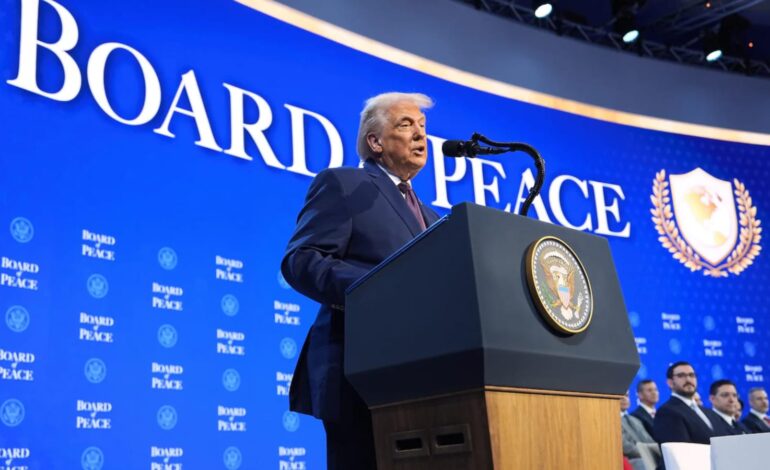

A major new element of Washington’s Gaza strategy is taking shape as the Board of Peace established under US President Donald Trump prepares for a pivotal meeting in the US capital. The session is expected to focus on how to deploy billions of dollars in pledged humanitarian aid and whether an international stabilisation force should be sent to the Palestinian enclave.
The initiative has quickly become one of the most closely watched developments in postwar Gaza planning. Supporters describe it as a pragmatic framework to accelerate recovery and security. Critics, however, are raising questions about the board’s mandate, its relationship with the United Nations, and the feasibility of its ambitious goals.
With representatives from dozens of countries expected to attend, the Washington meeting could mark a turning point in how the international community approaches Gaza reconstruction and governance.
Billions in Gaza Aid Already on the Table
Officials involved in the process say members of the Board of Peace have already pledged more than five billion dollars for humanitarian relief and early reconstruction in Gaza. The upcoming meeting will focus heavily on how that funding should be prioritised and distributed.
According to advisers, the initial funds are intended to jumpstart recovery in areas most heavily damaged during the conflict. Immediate priorities are expected to include housing, essential services, and critical infrastructure.
One of the most ambitious proposals under discussion involves plans to construct roughly one hundred thousand homes in Rafah over the next three years. If implemented, the project would represent one of the largest coordinated housing efforts in Gaza’s recent history.
However, officials caution that releasing funds will likely be tied to security conditions on the ground. This linkage between reconstruction and stability remains a central feature of the broader US approach.
International Stabilisation Force Under Review
Beyond financial aid, one of the most sensitive agenda items is the potential deployment of an international stabilisation force to Gaza. According to US officials, the proposed mission would have a multi layered mandate focused on both security and institutional support.
The force could be tasked to
-
Train Palestinian security services
-
Help maintain the Gaza ceasefire
-
Support efforts to disarm Hamas
-
Provide protection for reconstruction projects
While precise troop numbers have not been finalised, officials indicate that the mission could eventually involve several thousand personnel. The scale will depend on commitments from participating countries and the evolving security environment.
Importantly, Indonesia has already signalled willingness to contribute troops if the mission moves forward. This early indication of support suggests that Washington may be able to assemble at least a core coalition.
Nevertheless, the proposal remains politically sensitive and operationally complex.
Broad International Participation Expected
The Washington session is expected to draw representatives from nearly fifty countries along with officials from the European Union. This wide turnout reflects strong global interest in Gaza’s future but also highlights the complexity of coordinating such a large multinational effort.
Diplomats say the Board of Peace was initially conceived as a mechanism to oversee ceasefire implementation and reconstruction following the Israel Hamas war. However, its potential scope appears to be expanding.
President Trump has suggested that the body could eventually play a role in addressing conflicts beyond Gaza. That possibility has sparked debate among diplomats who are wary of creating overlapping international frameworks.
Even so, the broad attendance at the upcoming meeting indicates that many governments are willing to engage at least in the early stages.
Backed by UN Framework but Questions Persist
The Board of Peace operates with a mandate linked to the United Nations Security Council. However, the initiative has generated unease in parts of the international community.
Some member states and policy experts are concerned that the board could evolve into a parallel diplomatic structure that might sideline established UN mechanisms. Others argue that the initiative is a necessary interim solution given the urgency of Gaza’s humanitarian needs.
Analysts note that much will depend on how closely the board coordinates with existing UN agencies on the ground. Effective cooperation could ease concerns. Poor alignment, by contrast, could complicate international efforts.
For now, the question of institutional balance remains one of the most closely watched aspects of the initiative.
Part of a Wider Gaza Strategy
The Board of Peace is a central pillar of the current US administration’s broader twenty point Gaza peace framework. Washington’s approach explicitly links large scale reconstruction to improved security conditions.
Under this model, major rebuilding efforts would proceed only after Hamas is disarmed and a stable governance environment is established in the enclave. Supporters argue that this sequencing is necessary to prevent renewed conflict from destroying newly built infrastructure.
Advocates say the plan could
-
Accelerate humanitarian recovery
-
Attract private investment
-
Improve long term security conditions
-
Strengthen Palestinian institutions
However, critics question whether the prerequisites are realistic given Gaza’s complex political landscape.
Why the Washington Meeting Matters
The upcoming gathering is widely seen as a critical test of whether the Board of Peace can transition from concept to operational reality. Several key indicators will signal whether the initiative is gaining traction.
Observers will closely watch
-
The pace of fund disbursement
-
Which countries commit troops
-
Whether the ceasefire framework holds
-
The role assigned to Palestinian authorities
-
The degree of coordination with the United Nations
Financial markets are also monitoring developments because Gaza stability can influence broader Middle East risk sentiment. Energy traders and regional investors are particularly sensitive to shifts in geopolitical risk.
In many ways, the meeting will serve as an early stress test for the entire postwar framework.
Major Challenges Still Loom
Despite the ambitious agenda, analysts warn that significant hurdles remain. Rebuilding Gaza has historically proven difficult even under less complex circumstances.
Key challenges include
-
Political divisions over Gaza governance
-
Ongoing security risks on the ground
-
Coordination among dozens of countries
-
Sustaining long term funding flows
-
Clarifying the relationship with the United Nations
Each of these factors could slow implementation if not carefully managed.
Security conditions remain perhaps the most immediate concern. Without a durable ceasefire and credible enforcement mechanism, large scale reconstruction projects may struggle to proceed.
Regional and Global Implications
The Board of Peace initiative carries implications that extend well beyond Gaza itself. If successful, it could become a model for post conflict stabilisation in other regions. If it falters, it could reinforce scepticism about large multinational reconstruction frameworks.
Regional governments are watching closely, particularly those concerned about spillover instability. European partners are also assessing how the initiative fits into broader Middle East diplomacy.
Meanwhile, humanitarian organisations are focused on whether aid delivery can accelerate quickly enough to address urgent needs on the ground.
The stakes, therefore, are both immediate and long term.
What Comes Next
Following the Washington meeting, the next phase will likely involve technical planning groups, troop commitment negotiations, and detailed funding schedules.
Key milestones to watch in the coming months include
-
Formal troop pledges from participating nations
-
Initial release of reconstruction funds
-
Establishment of security training programmes
-
Progress on housing construction in Rafah
-
Evidence of sustained ceasefire compliance
Each step will provide clues about whether the Board of Peace is moving toward full operational capacity.
Conclusion
The upcoming Washington meeting of President Trump’s Board of Peace marks a significant moment in efforts to shape Gaza’s postwar future. With billions in pledged aid and potential international troop deployments under discussion, the initiative represents one of the most ambitious reconstruction frameworks currently on the table.
At the same time, the plan faces intense scrutiny over its mandate, coordination with the United Nations, and long term feasibility. Much will depend on whether the board can translate political momentum into practical results on the ground.
For now, global policymakers, regional governments, and humanitarian agencies will be watching closely. The decisions made in Washington could play a decisive role in determining whether Gaza moves toward sustained recovery or continued uncertainty in the years ahead.