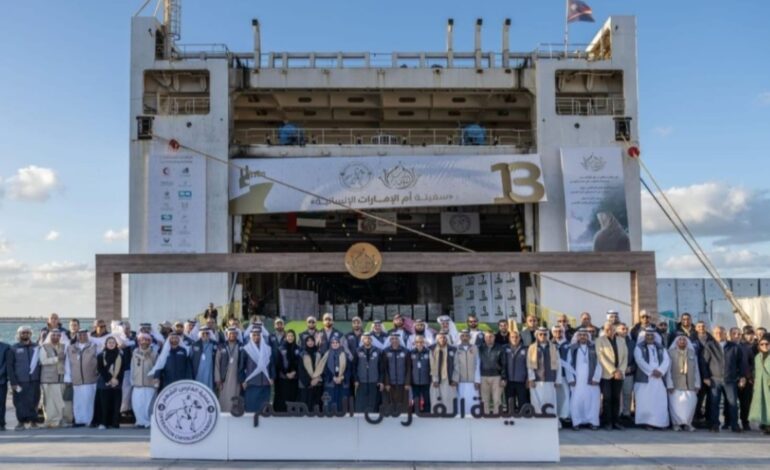

The United Arab Emirates (UAE) has strengthened its humanitarian commitment to Gaza after the aid vessel “Mother of the Nation” (Umm Al Emarat) arrived in Egypt carrying a massive shipment of relief supplies. The move underscores the UAE’s continued leadership in regional humanitarian assistance and its sustained support for Palestinian civilians facing severe shortages amid ongoing conflict.
The ship’s arrival at Egypt’s Al Arish Port marks another major milestone in the country’s relief campaign under Operation Chivalrous Knight 3. With more than 7,300 tonnes of critical aid onboard, the mission reflects the UAE’s strategy of maintaining a steady humanitarian corridor to Gaza during a prolonged crisis.
As humanitarian needs in Gaza remain acute, the latest shipment highlights Abu Dhabi’s long-term approach: combining scale, logistics coordination, and sustained delivery rather than one-off emergency responses.
UAE Humanitarian Ship Reaches Egypt
The UAE humanitarian vessel, widely known as Umm Al Emarat or Mother of the Nation, successfully docked at Al Arish Port in Egypt, a key staging point for aid bound for Gaza.
Officials confirmed the cargo includes essential food supplies, medical equipment, shelter materials, and family support items intended to ease the worsening humanitarian situation inside the Gaza Strip.
The vessel was received by UAE Ambassador to Egypt Hamad Obaid Al Zaabi, alongside representatives from Emirati charitable organisations and Egyptian partners. The delegation supervised the unloading process and coordinated the next phase of logistics.
The arrival demonstrates the UAE’s continued operational capacity to deliver large-scale humanitarian shipments despite the complex regional environment.
Part of Operation Chivalrous Knight 3
The aid mission forms part of Operation Chivalrous Knight 3, the UAE’s flagship humanitarian initiative launched under the directives of President Sheikh Mohamed bin Zayed Al Nahyan.
Since its launch, the operation has evolved into one of the most sustained and structured relief efforts supporting Gaza. It integrates air, land, and maritime corridors to ensure continuous aid flow into the territory.
Officials emphasised that the latest shipment reflects the UAE’s long-term humanitarian strategy, which prioritises:
-
Continuity of aid deliveries
-
Rapid emergency response capability
-
Multi-agency coordination
-
Scalable logistics infrastructure
-
Targeted support based on field assessments
Rather than relying on sporadic aid drops, the UAE has focused on building what it describes as a predictable humanitarian pipeline
What the 7,300-Tonne Aid Shipment Contains
The cargo exceeding 7,300 tonnes includes a broad range of life-saving and relief materials prepared by 16 UAE humanitarian organisations working under the national relief framework.
Key supplies include:
-
Food parcels and staple nutrition items
-
Medical equipment and healthcare supplies
-
Shelter materials and emergency kits
-
Clothing and family support packages
-
Hygiene and basic household items
Officials said the shipment was carefully assembled based on real-time needs assessments conducted by humanitarian teams monitoring conditions inside Gaza.
This targeted approach aims to maximise impact and ensure that the most urgent civilian needs are addressed.
Strong Focus on Food Security and Medical Aid
Food Assistance Priority
Food support remains a central pillar of the UAE’s Gaza relief strategy. Humanitarian agencies have repeatedly warned of mounting pressure on food systems inside the enclave, with many families facing limited access to basic nutrition.
The latest shipment includes large quantities of family food parcels designed to support vulnerable households for extended periods.
Key goals of the food aid include:
-
Preventing acute hunger
-
Stabilising household food access
-
Supporting children and vulnerable groups
-
Reducing pressure on local supply chains
Medical Support Critical
Medical assistance forms another major component of the shipment. Hospitals and clinics in Gaza continue to operate under severe strain due to shortages of equipment, medicines, and consumables.
The UAE’s medical cargo is intended to:
-
Support overwhelmed healthcare facilities
-
Provide essential treatment supplies
-
Strengthen emergency response capacity
-
Sustain critical care services
Officials noted that healthcare support remains one of the most urgent humanitarian priorities in the current phase of the crisis.
Next Step: Transfer Into Gaza
After unloading at Al Arish, the aid will be transported to the UAE’s humanitarian logistics hub in the Egyptian city. From there, supplies will be prepared for controlled entry into Gaza in coordination with international partners and relevant authorities.
This multi-stage logistics chain is necessary due to the complex operational environment governing aid access into the enclave.
The UAE’s structured delivery model typically follows this pathway:
-
Maritime delivery to Al Arish
-
Transfer to UAE logistics warehouses
-
Sorting and prioritisation
-
Coordination with international agencies
-
Land entry into Gaza
-
Distribution to civilian beneficiaries
Officials say this system is designed to ensure efficiency, accountability, and rapid deployment despite operational constraints.
Part of a Larger Humanitarian Sea Bridge
The Mother of the Nation vessel is the 13th ship dispatched by the UAE as part of its ongoing maritime aid corridor to Gaza.
This sustained humanitarian sea bridge reflects a broader Emirati strategy to maintain predictable and scalable aid flows rather than relying on isolated emergency shipments.
Why the sea bridge matters:
-
Ensures consistent supply volumes
-
Reduces gaps in humanitarian delivery
-
Supports long-term relief planning
-
Enhances logistics predictability
-
Strengthens coordination with partners
By maintaining repeated maritime deliveries, the UAE aims to provide reliable and sustained support to affected populations.
UAE’s Longstanding Support for Gaza
The latest shipment builds on more than two and a half years of continuous humanitarian assistance provided by the UAE to Palestinians.
Officials describe the country’s approach as combining speed, scale, and sustainability.
Core pillars of the UAE model:
-
Rapid emergency response
-
Sustained relief operations
-
Partnerships with international agencies
-
Long-term humanitarian planning
-
Integrated air-land-sea delivery network
This framework has positioned the UAE as one of the most active regional contributors to Gaza relief efforts.
Humanitarian Diplomacy in Action
Beyond the immediate humanitarian impact, the mission also reflects the UAE’s broader humanitarian diplomacy strategy.
Through large-scale relief operations, the country seeks to:
-
Support civilian populations in crisis zones
-
Strengthen regional stability
-
Demonstrate global humanitarian leadership
-
Build coordinated international response mechanisms
-
Enhance soft power through aid delivery
Analysts note that such missions serve dual purposes — delivering tangible assistance while reinforcing the UAE’s profile as a proactive humanitarian actor.
Logistics Challenges Behind the Scenes
Delivering humanitarian aid to Gaza remains operationally complex. Aid shipments must navigate:
-
Security screening procedures
-
Cross-border coordination requirements
-
Transportation bottlenecks
-
Warehouse capacity constraints
-
Rapidly changing ground conditions
Officials involved in the mission acknowledged that moving supplies from ports to final destinations requires continuous coordination with multiple stakeholders.
Despite these challenges, UAE teams say they are maintaining a steady and reliable humanitarian pipeline.
Why This Shipment Matters Now
The timing of the latest aid delivery is particularly significant. Humanitarian agencies continue to warn of sustained pressure on:
-
Food systems
-
Healthcare services
-
Shelter capacity
-
Civilian infrastructure
Large-scale shipments like the Mother of the Nation mission help:
-
Stabilise short-term supply gaps
-
Support medical facilities
-
Strengthen food security
-
Prepare for seasonal humanitarian needs
-
Reduce volatility in aid availability
With regional tensions still elevated, sustained humanitarian flows remain critical to preventing further deterioration of civilian conditions.
Regional and Global Response Context
The UAE’s maritime aid corridor operates alongside broader international relief efforts aimed at preventing a deeper humanitarian crisis in Gaza.
However, humanitarian officials widely acknowledge that needs continue to outpace available supplies, making consistent large-volume shipments essential.
By maintaining regular deliveries, the UAE is helping to:
-
Improve predictability of aid flows
-
Support coordinated relief planning
-
Reduce supply disruptions
-
Strengthen international humanitarian response
This sustained model is increasingly viewed as a best-practice approach in protracted crisis environments.
What Comes Next Under Operation Chivalrous Knight 3
Humanitarian officials indicate that further shipments under Operation Chivalrous Knight 3 are expected as the UAE continues to scale its relief operations.
Potential future focus areas include:
-
Expanded food security support
-
Additional medical supply shipments
-
Winter and seasonal relief packages
-
Infrastructure and shelter assistance
-
Enhanced field coordination mechanisms
The continuation of the maritime corridor suggests the UAE is preparing for a long-duration humanitarian engagement rather than a short-term emergency response.
Outlook: UAE Strengthens Role as Key Humanitarian Actor
The arrival of the UAE’s Mother of the Nation aid ship in Egypt with more than 7,300 tonnes of supplies underscores the country’s ongoing commitment to humanitarian relief in Gaza.
As Operation Chivalrous Knight 3 continues, the UAE is positioning itself as a major provider of sustained, large-scale assistance during one of the region’s most challenging humanitarian crises.
Through structured logistics, repeated shipments, and multi-agency coordination, the Emirates is reinforcing its role as a leading humanitarian actor in the Middle East.
For observers across the UAE and the wider region, this mission highlights how humanitarian policy, logistics capability, and diplomatic outreach are increasingly working together in modern crisis response.
With needs in Gaza still significant and the regional situation fluid, continued shipments like the Mother of the Nation will likely remain a critical lifeline in the months ahead.