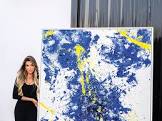

In the world of contemporary art, some artists paint what they see. Others paint what they feel. For Marjorie Raymond, art begins not with observation but with emotion. Her paintings are powerful visual translations of feelings layered, textured, and deeply personal.
Over more than two decades, Raymond has developed a unique artistic language that transforms raw emotion into monumental abstract works. Using unconventional materials such as sand, charcoal, stone, and even diamond dust, she creates canvases that are not only visually striking but physically immersive.
Today, her work can be found in exclusive locations and prestigious collections around the world, including luxury spaces like Bvlgari Mansions and Atlantis The Royal Penthouse.
But behind the scale and grandeur of her work lies a simple philosophy: art is a way of feeling and expressing life itself.
A Journey Across Cultures
Marjorie Raymond’s story begins with a journey across continents. Born in France, raised in Brazil, and now based in Dubai, her life has been shaped by diverse cultures and landscapes. Each place she has lived has left an emotional imprint on her artistic vision.
Growing up in Brazil exposed her to vibrant colors, nature, and emotional intensity—elements that still echo in her paintings today. France, with its deep artistic heritage, provided another layer of influence, while Dubai’s cosmopolitan environment added a modern and global perspective.
Raymond herself acknowledges the profound impact of these experiences. She once explained that living across multiple cultures shaped not only how she sees the world but also how deeply she feels it.
This multicultural background is visible in her art. Her paintings often feel like emotional landscapes places where memories, experiences, and cultures collide.
Art That Begins with Emotion
Unlike traditional artists who start with sketches or visual references, Raymond begins with a feeling.
Her creative process is deeply intuitive. She does not paint what she sees in front of her; instead, she paints what she experiences internally. For Raymond, the canvas becomes a space where emotions take physical form.
She once described her philosophy simply: she creates what she feels, not what she sees.
This approach places her work firmly within the world of abstract art, where meaning is not dictated but discovered. Each viewer may interpret her paintings differently, depending on their own emotions and experiences.
In this sense, her art becomes a conversation between the artist and the audience.
The Power of Texture
One of the most striking aspects of Raymond’s work is texture.
Her canvases are rarely smooth surfaces. Instead, they are layered with raw materials such as sand, charcoal, rocks, and diamond dust. These elements give her paintings a tactile quality that invites viewers to look closer.
Texture plays a crucial role in communicating emotion. A rough, heavy surface may represent intensity or struggle, while softer layers may evoke calmness or reflection.
This physical dimension makes her art almost sculptural. Rather than existing purely as images, her paintings become objects that occupy space and interact with light.
Some of her works are monumental in size, stretching across large canvases that dominate the rooms they inhabit. The scale adds to the emotional impact, allowing viewers to feel immersed in the artwork rather than simply observing it.
A Career Built on Passion
Marjorie Raymond’s career spans more than 25 years, but her journey into art began much earlier.
As a child, she was already drawn to painting and sculpting. Unlike many artists, however, Raymond did not follow a formal academic path in art. She is largely self-taught, learning through experimentation, passion, and persistence.
Over time, this self-driven exploration allowed her to develop a distinctive style that is instantly recognizable.
Her work has been exhibited internationally and collected by private clients, art enthusiasts, and luxury hospitality brands. Some of her paintings have also been featured in prestigious locations around the world.
Despite her growing recognition, Raymond remains grounded in the emotional purpose of her art. For her, success is not measured by fame but by authenticity.
The Language of Abstract Art
Abstract art can sometimes feel mysterious or difficult to understand. But Raymond approaches abstraction in a deeply human way.
Instead of focusing on shapes or theories, she uses abstraction as a tool for emotional expression.
Her paintings often feature bold color contrasts, layered surfaces, and organic forms. These elements come together to create compositions that feel dynamic and alive.
Each piece tells a story though not in the traditional sense. Rather than depicting scenes or figures, her work captures moments of emotional intensity.
Viewers might sense joy, tension, serenity, or vulnerability depending on how they engage with the painting.
In this way, Raymond’s art reflects one of the most powerful ideas in modern art: emotion itself can be the subject.
Monumental Works for Monumental Spaces
Another defining characteristic of Raymond’s work is scale.
Many of her paintings are large, commanding pieces designed for expansive architectural environments. These monumental artworks are often displayed in luxury residences, private collections, and high-end hospitality spaces.
Because of their size and texture, they interact strongly with the surrounding space. Light changes the way the surfaces appear, revealing different details throughout the day.
This makes her art especially suited for modern architectural interiors, where minimalistic spaces allow the artwork to become the focal point.
In many ways, Raymond’s paintings function like emotional landscapes—expansive, immersive, and impossible to ignore.
The Emotional Journey of Creation
Creating these works is far from a quick process.
Some paintings take weeks to complete, while sculptural pieces can require months or even a year. The process involves layering materials, adjusting textures, and allowing each stage to develop naturally.
For Raymond, the act of creation is almost therapeutic.
Each brushstroke or layer of material reflects a moment of emotional release. The canvas becomes a place where experiences are processed and transformed.
This deeply personal approach is one of the reasons her art resonates so strongly with viewers.
When people encounter her work, they often feel an immediate emotional response—even if they cannot fully explain why.
Art That Transcends Borders
Although Raymond is based in Dubai, her work has reached audiences across the globe.
Collectors from Europe, the Middle East, Asia, and the Americas have added her paintings to their collections.
This international appeal reflects the universal nature of emotion. While cultures may differ, feelings such as joy, longing, and introspection are shared across humanity.
Raymond’s art taps into these universal experiences, allowing people from different backgrounds to connect with her work.
It is this emotional universality that gives her paintings their lasting impact.
The Future of Marjorie Raymond’s Art
As the contemporary art world continues to evolve, artists like Marjorie Raymond are redefining what abstraction can be.
Her work blurs the boundaries between painting and sculpture, emotion and material, personal experience and universal expression.
With ongoing exhibitions and growing recognition, Raymond’s influence in the world of contemporary abstract art is likely to continue expanding.
Yet despite the scale of her work and the prestige of her collectors, her artistic philosophy remains refreshingly simple.
She creates not to prove anything—but to express.
Why Her Art Matters Today
In an age dominated by fast-moving digital content, Raymond’s art invites us to slow down.
Her paintings demand attention. They encourage viewers to pause, observe, and feel.
This is perhaps the greatest power of abstract art: it allows space for reflection.
Instead of telling us exactly what to think, Raymond’s work encourages us to explore our own emotional landscapes.
And in doing so, it reminds us that art is not just something we see—it is something we experience.