
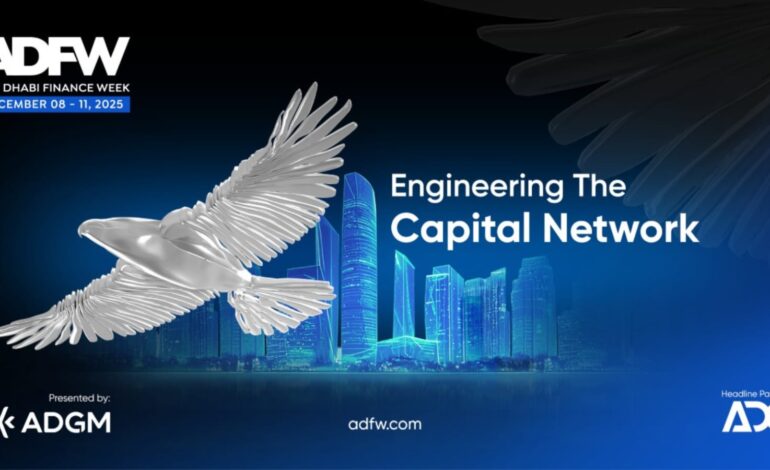

From 8-11 December 2025, Abu Dhabi will host the 2025 edition of Abu Dhabi Finance Week (ADFW), a four-day global gathering of financial heavyweights, institutional investors, fintech innovators, policy-makers.
Under the theme “Engineering the Capital Network”, the event marks a significant milestone in the UAE capital’s ambition to cement its status as a global centre for capital, innovation, and sustainable finance.
This year’s edition comes at a time when Abu Dhabi’s economy is showing robust growth, buoyed by diversification, a strong real estate market, and expanding sectors beyond oil.
Why Abu Dhabi — From Oil to “Capital of Capital”
Strategic Shift Toward Economic Diversification
For decades, the UAE — including Abu Dhabi — has worked to reduce its dependence on oil. The government has invested heavily in non-oil sectors: finance, real estate, technology, tourism, sustainable energy.
Simultaneously, regulatory and business reforms have made Abu Dhabi more attractive for global investors — including the establishment and maturation of Abu Dhabi Global Market (ADGM).
ADGM & The Rise of a Regional Financial District
Launched in 2013 and operational since 2015, ADGM has rapidly grown into the UAE’s primary international financial centre. Located on Al Maryah Island, ADGM’s jurisdiction spans millions of square metres — offering one of the region’s largest dedicated financial and business districts.
Over the past few years, ADGM has attracted global banks, asset managers, fund houses, private-equity firms, family-offices and fintech innovators.
High-profile names such as global investment funds, sovereign-wealth affiliates, and international banks are now using Abu Dhabi as a hub for regional operations.
All this sets the stage for ADFW to serve as the annual convergence point for global capital flows — where investments, regulations, ideas, and partnerships meet.
What to Expect at Abu Dhabi Finance Week 2025
Event Overview & Scale
Dates: 8–11 December 2025.
Organiser: ADGM, with major support from headline partner ADQ and other strategic partners including major banks.
Scope: Over 60 events, 300+ sessions, and 750+ global speakers from banks, asset managers, investors, fintech firms, regulators, and governments.
Representation: CEOs, chairpersons, founders, and top-level executives representing institutions managing more than USD 62–63 trillion in assets — over half of global GDP.
Key Themes: Digital assets & real-world asset tokenisation, sustainable finance / ESG, geopolitical risk and global economy, AI and technology in finance, energy finance, the “Falcon Economy” (UAE’s push for diversified growth), humanitarian investments, and regulatory innovation.
Notable Speakers & Participants
The speaker list includes senior leadership from top global financial institutions — spanning traditional banks, asset managers, investment funds, fintech firms and alternative-asset players.
Among them: heads of major banks, international fund managers, private equity and hedge-fund firms, as well as influential economists, policy-makers and regulators.
Major global players choosing Abu Dhabi as their base — such as asset-managers, investment banks, and regional offices of global firms
What Will Be on the Table — Key Discussion Areas • Digital Assets & Tokenisation
One of the most spotlighted areas this year is the tokenisation of real-world assets— turning physical or conventional investments into tradable digital assets. This reflects a global trend and points to Abu Dhabi positioning itself as a hub for regulated digital-asset finance.
• ESG and Sustainable Finance
Given global climate commitments and regional energy transitions, sustainable finance — including green bonds, carbon-credit markets, climate-resilient infrastructure funding — will be major topics. ADFW provides a platform to align private capital with climate and ESG goals.
• Global Capital Flows & Geopolitics
With macroeconomic uncertainties — from energy markets to global geopolitical tensions — sessions will examine how capital flows, monetary policy shifts, and regional dynamics affect investment strategies worldwide. Abu Dhabi aims to project itself as a stable, diversified base amidst global uncertainty.
• Tech, Innovation & Fintech — Including AI
Financial innovation, digital finance, fintech regulation, AI in finance, and disruptive financial technologies will be under discussion — reflecting how technology and capital markets are converging rapidly worldwide.
• Infrastructure and “Falcon Economy” Investments
UAE’s push — often called the “Falcon Economy” — involves diverting capital toward infrastructure, logistics, tourism, renewable energy, healthcare, education, and technology. ADFW will likely surface new infrastructure-investment plans, public-private partnerships, and deals related to these sectors.
• Humanitarian & Social Impact Finance
In a notable twist, ADFW 2025 will include sessions on financing global health, humanitarian projects, and philanthropic investment, blending capital markets with social responsibility — especially with high-profile attendees like Bill Gates expected to participate.
What This Means for Abu Dhabi and the UAE — Strategic Implications
Cementing Abu Dhabi’s Role as a Global Finance Hub
With ADFW and ADGM’s rising prominence, Abu Dhabi is positioning itself alongside global financial capitals — a “capital of capital,” not just a regional player. The scale of global capital converging here shows growing trust in the UAE’s regulatory, fiscal, and institutional frameworks.
The influx of global firms, asset managers, and institutional investors — plus local policy support — strengthens Abu Dhabi’s financial ecosystem, offering depth, diversity, and resilience.
Diversification Beyond Oil — Building a Sustainable, Knowledge-Based Economy
The variety of sessions — from fintech to ESG to real-asset tokenisation to humanitarian investments — shows UAE’s push to diversify from hydrocarbons toward sustainable, knowledge- and capital-intensive sectors.
This helps insulate the economy against oil-price volatility, while building long-term infrastructure in tech, finance, sustainable energy, and global capital services.
Attracting Global Capital, Talent & Innovation
ADFW brings decision-makers, capital holders, innovators — and in doing so, attracts talent, ideas, and global business. This encourages human-capital flows, knowledge transfer, and innovation ecosystems (venture capital, fintech startups, green finance, asset management firms, etc.).
Over time, Abu Dhabi could emerge as a regional or even global hub for fintech, fund management, sustainable finance, and D-assets (digital assets), rivaling established hubs like London, New York, Singapore or Hong Kong.
Investment Flows, Deal-Making, and New Partnerships
For investors, businesses, and governments — ADFW could catalyze major deals: infrastructure funding, green-energy projects, asset-backed tokenisation, real-estate funds.
For the region, this could mean increased foreign direct investment (FDI), job creation, growth of financial services, and deeper integration of Gulf economies into the global capital network.
Soft-Power, Reputation & Strategic Positioning
Hosting such a large, global financial event helps raise Abu Dhabi’s profile internationally — as stable, forward-looking, and business-friendly. This enhances the UAE’s soft power, geopolitical relevance, and attractiveness to global institutions.
Risks, Challenges & What to Watch
However, such rapid growth and openness come with challenges — and success is not guaranteed. Key risks include:
Regulatory & Governance Risks
As the UAE expands into digital assets, tokenisation, and novel financial instruments, ensuring robust regulation will be critical: risk management, anti-money-laundering safeguards, transparency, investor protection, and governance standards will need to match global best practices.
Global Economic & Geopolitical Headwinds
Global capital flows are volatile. Slowing global economy, interest-rate shifts, geopolitical conflicts, energy-market instability, or global financial uncertainty could deter investment or shift capital elsewhere.
Oversupply & Market Saturation
If many financial firms relocate to Abu Dhabi at once, or if too many similar funds / enterprises compete, there could be saturation — compressing yields, increasing competition, and straining infrastructure and talent supply.
Talent & Human-Capital Constraints
Attracting global talent is easier said than done — regulatory, cultural, visa, housing, and lifestyle factors can be barriers. Continued growth requires not just capital but human capital, innovation ecosystems.
Dependence on Policy Continuity
Much depends on policy consistency, regulatory clarity, and continued government support. Any abrupt changes in regulation, taxation.
What to Watch — Key Forecasts & Signals
As ADFW 2025 unfolds, several signals will be key to see whether Abu Dhabi truly cements its status as a global hub:
Major announcements & deal signings — new funds, green-energy financing deals, asset-tokenisation frameworks, infrastructure investments.
International firms setting up regional offices or funds in ADGM — relocations or expansions by large asset managers, banks, fund houses.
Regulatory frameworks unveiled — especially around digital assets, ESG, sustainable finance, cross-border capital flows.
Talent inflows & startup ecosystem growth — increase in fintech, asset-management startups, VC firms, tech-finance collaboration.
Public-private partnerships (PPP) deals — in infrastructure, energy, tech, green finance, regional investment.
Media and reputation fallout — coverage, global perception, confidence from international investors, ranking changes in global financial indices.
Conclusion
Abu Dhabi Finance Week 2025 is more than a conference — it is a defining symbol of Abu Dhabi’s ambition to transform from a Gulf capital known for oil-wealth into a global financial centre.
With vast global capital being mobilized, comprehensive participation from top global financial institutions, a broad agenda.
If executed well, the ripple effects — across regional investment, global finance, sustainable growth, and human-capital development — could be profound.




1 Comment
[…] announced the initiative during Abu Dhabi Finance Week 2025, outlining how advanced biotechnology could reshape food systems in one of the world’s most […]
Comments are closed.