ADSW Youth Action Challenges Climate Pessimism

Across the world, climate discourse increasingly reflects fatigue rather than momentum. Headlines focus on political division, diluted Environmental, Social and Governance (ESG) standards, and slower policy action. As a result, many observers—especially young people—feel discouraged and question whether meaningful climate progress is still possible.
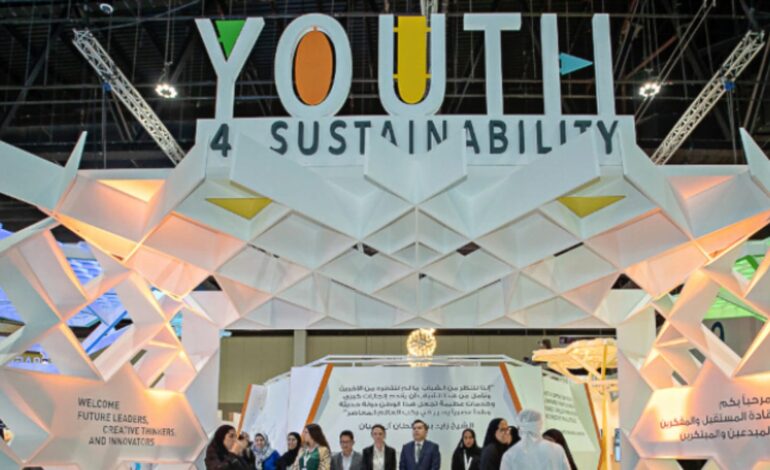
However, this narrative tells only part of the story. At Abu Dhabi Sustainability Week (ADSW) 2026, youth engagement demonstrated a powerful counterpoint to climate pessimism. Instead of retreating from sustainability, young people are shifting the focus from abstract ambition to practical execution, systems thinking, and long-term delivery. Their actions suggest that climate pessimism is not only incomplete but also counterproductive.
Understanding the Rise of Climate Pessimism
Climate pessimism did not emerge without reason. In several regions, governments have softened ESG reporting requirements, while global political attention has shifted toward short-term economic and geopolitical pressures. Consequently, climate action often appears deprioritised.
Moreover, public discourse increasingly frames sustainability as costly, complex, or politically divisive. For young people who grew up amid urgent climate warnings, this shift can feel like a retreat from responsibility.
Yet this interpretation overlooks a crucial transition already underway. Climate action is not disappearing; instead, it is changing form. Increasingly, the emphasis has moved from broad declarations and pledges toward implementation, regulation, measurement, and accountability. Youth engagement at ADSW highlights this evolution clearly.
ADSW as a Platform for Youth-Led Execution
At ADSW 2026, youth participation extended far beyond symbolic representation. The Youth for Sustainability Forum and Hub created a space where young people actively engaged with policy frameworks, technology deployment, finance mechanisms, and behavioural change strategies.
Rather than focusing on abstract ideals, discussions centred on how climate solutions move from concept to execution. Workshops, roundtables, and collaborative sessions connected students and young professionals directly with policymakers, researchers, investors, and industry leaders.
As a result, youth at ADSW did not merely absorb information; they contributed to problem-solving conversations that shape real-world outcomes. This shift from passive attendance to active participation challenges the idea that climate momentum is fading.
Why Youth Engagement Matters More During Execution Phases
When climate action moves from ambition to delivery, the skills required also change. Implementation demands:
-
Systems thinking
-
Data literacy
-
Cross-sector collaboration
-
Long-term planning
These are precisely the areas where youth engagement adds value. Young participants often approach sustainability with interdisciplinary mindsets, combining technology, economics, policy, and social behaviour rather than viewing climate issues in isolation.
Furthermore, youth are uniquely positioned to sustain long-term initiatives. Because climate transitions unfold over decades, engaging future leaders during the execution phase ensures continuity rather than disruption.
Moving Beyond Rhetoric: Policy and Measurement
One reason climate pessimism persists is the belief that commitments lack enforcement. However, this assumption increasingly clashes with reality—especially in regions prioritising regulatory frameworks.
For example, in the UAE, structured policies mandate emissions reporting and accountability, reinforcing the principle that measurable data drives effective management. Such frameworks shift sustainability from aspirational language to operational reality.
At ADSW, youth participants engaged directly with these policy mechanisms. By understanding how regulation, measurement, and compliance operate, they gained insight into the machinery of climate execution—an understanding far more empowering than rhetoric alone.
Universities as Living Laboratories for Climate Action
Education plays a pivotal role in translating climate ambition into practice. Increasingly, universities function not just as learning institutions but as living laboratories for sustainability.
University campuses mirror small cities. They manage:
-
Energy systems
-
Water consumption
-
Food supply chains
-
Waste management
-
Transportation networks
As a result, students can test sustainability solutions in real-world conditions. At ADSW, examples from institutions such as NYU Abu Dhabi highlighted how students participate in campus sustainability committees, operational projects, and policy simulations.
This experiential learning transforms climate education from theory into applied knowledge. Consequently, students graduate with a practical understanding of how sustainability systems operate—and how they can improve them.
Global Exposure and Negotiation Experience
Youth engagement at ADSW also extends into global climate diplomacy. Some students participate in delegations to international climate negotiations, including COP summits. Through these experiences, they observe firsthand how multilateral agreements form, where negotiations stall, and why compromise matters.
Importantly, this exposure builds realism rather than disillusionment. When young people understand the constraints of global governance, they are less likely to succumb to pessimism and more likely to pursue incremental, achievable progress.
Thus, global engagement reframes climate action as a long-term process rather than a single breakthrough moment.
Collaboration as a Force Multiplier
Climate pessimism often assumes that isolated actors cannot move the needle. However, collaboration significantly amplifies impact.
The UAE Universities Climate Network, which now includes dozens of institutions, demonstrates how shared learning accelerates progress. By pooling research, aligning objectives, and exchanging best practices, universities rapidly increase collective capacity.
At ADSW, youth engagement reflected this collaborative ethos. Instead of competing for attention, participants focused on shared outcomes—an approach essential for climate execution.
Research Tailored to Regional Realities
Another source of climate pessimism lies in one-size-fits-all solutions that ignore local conditions. Effective climate action must reflect regional realities, including climate, biodiversity, economic structure, and social context.
Research initiatives discussed at ADSW emphasised region-specific insights, particularly for arid and semi-arid environments. Programmes that integrate academic research with public-sector and private-sector partnerships help translate science into actionable strategies.
Moreover, global initiatives combining research, leadership, and philanthropy now deploy tools such as AI-driven weather forecasting to support farmers in emerging economies. These solutions improve resilience and productivity, demonstrating that climate action delivers tangible benefits—not just emissions reductions.
Broadening the Definition of Climate Action
A critical takeaway from youth engagement at ADSW is that climate action extends far beyond environmental science. Lawyers shape regulatory frameworks. Economists design incentives. Procurement specialists influence supply chains. Designers improve usability. Communicators shift public behaviour.
For young people, this expanded definition creates opportunity rather than despair. Climate execution requires diverse skills, meaning more pathways to impact exist than commonly assumed.
As a result, pessimism narrows possibilities, while execution-oriented thinking expands them.
Why Climate Pessimism Becomes Counterproductive
Although skepticism can drive accountability, excessive pessimism undermines progress. When people believe solutions are futile, they disengage. This disengagement becomes self-fulfilling.
Youth engagement at ADSW illustrates the opposite dynamic. When young people see pathways for action—through policy, technology, education, and collaboration—they remain motivated and pragmatic.
In this context, pessimism distracts from the work of implementation. Progress rarely occurs through sweeping optimism or despair but through practical ambition—a mindset combining realism with determination.
A Generation Focused on Delivery
What distinguishes youth engagement at ADSW is not idealism alone but execution mindset. Young participants understand that:
-
Systems change incrementally
-
Data enables accountability
-
Collaboration accelerates outcomes
Rather than demanding perfection, they focus on improving systems piece by piece. This approach aligns closely with how real-world climate progress unfolds.
Therefore, youth action at ADSW does not deny challenges; instead, it responds to them constructively.
Conclusion: From Pessimism to Practical Momentum
Youth involvement at Abu Dhabi Sustainability Week demonstrates that climate pessimism is misplaced—and, more importantly, counterproductive. While global discourse may appear fragmented, execution on the ground continues to advance through policy, education, research, and collaboration.
By engaging deeply with systems, measurement, and implementation, young people are helping shift sustainability from aspiration to delivery. Their actions remind us that climate progress depends less on perfect narratives and more on sustained execution.
In the end, climate action is not failing; it is evolving. And as youth at ADSW show, when execution replaces abstraction, there remains strong reason for confidence in the future of sustainable solutions.