
On 8 December 2025, global health and philanthropic leaders gathered in Abu Dhabi under the auspices of the Mohamed bin Zayed Foundation for Humanity. This marks a critical moment for global public-health efforts as they face steep funding challenges in the coming years.
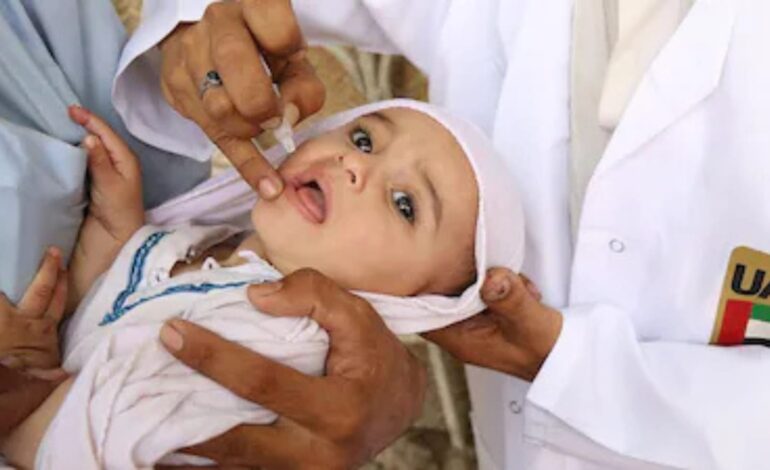
With this injection of funds, the campaign targets to protect nearly 370 million children annually, focusing especially on regions still battling endemic. The move is seen as a last-mile push for the global health community, amid concerns that recent aid-cutting.
Why This Pledge Matters — Context & Urgency
Polio: A Preventable Disease Still Threatening Millions
The Global Polio Eradication Initiative (GPEI), launched in 1988, remains the largest global public-health endeavor, aiming to eliminate polio. Thanks to massive vaccination campaigns over decades, polio incidence dropped by more than 99%. But eradication has proved stubborn: conflict zones, weak health systems, displaced populations.
Today’s pledge comes at a precarious juncture. The GPEI anticipates a 30% budget cut in 2026, with a projected funding deficit of US$ 1.7 billion through 2029. These shortfalls endanger vaccination campaigns, surveillance, and disease-containment efforts.
A $1.9B Injection — Closing the Funding Gap, For Now
The Abu Dhabi pledging event significantly narrows the resource gap, bringing it down to approximately US$ 440 million for the 2022–2029 strategy. Major contributions include US$ 1.2 billion from the Bill & Melinda Gates Foundation.
In short: at a moment when global aid is shrinking, the pledge offers a lifeline — but it may not be enough. What follows will be a test of execution.
Why the UAE Hosting Matters — Strategic Significance
That the pledging event took place in Abu Dhabi is more than symbolic. The UAE, through the Mohamed bin Zayed Foundation for Humanity, has established itself as a key player in international health philanthropy. By convening donors, governments, and global health organizations. It demonstrates how non-traditional actors and Gulf philanthropies are stepping up to global health challenges.
This shift suggests a broader reconfiguration of global health financing: from public aid and donor-heavy development budgets toward diversified, multipolar networks of funding. Where Middle East stakeholders, philanthropic foundations, and global coalitions combine resources. The success of the polio pledge could be a blueprint for future campaigns targeting neglected diseases.
What the Funding Will Support — Key Priorities Post-2025
Expanded Immunization & Vaccination Drives
Funds will support vaccination campaigns in polio-endemic and high-risk countries — including remote areas, conflict zones and regions with low vaccine coverage. The goal: immunize hundreds of millions of children under 5 and ensure periodic booster campaigns.
Surveillance, Testing & Rapid Response
Polio eradication isn’t just about vaccines — it needs robust surveillance systems to detect outbreaks, monitor wastewater signals, and respond quickly with rapid immunization in case of flare-ups. The new funding will help sustain such systems, which are resource-intensive but critical.
Community Engagement & Outreach
Achieving coverage in distrustful, remote or conflict-affected communities requires more than clinics — it needs outreach, public trust, education, logistical coordination and local partnerships. A portion of the funds is earmarked for these social-mobilisation efforts.
Research & Variant Management
Polio has evolved over time. New funding will support research, variant surveillance, and improved vaccine technologies to tackle wild-type and vaccine-derived poliovirus outbreaks.
Health System Strengthening
Broader investment in local health infrastructure — cold-chain management, primary care access, trained personnel — will strengthen resilience not only to polio, but to other infectious and emerging diseases
In essence, the pledge isn’t just about a one-off drive — it’s about building durable systems capable of sustaining eradication once achieved.
Challenges Ahead — Why $1.9B Won’t Solve Everything
Donor Fatigue, Lingering Funding Gaps
Even after the latest pledge, GPEI still needs roughly US$ 440 million through 2029. If global economic headwinds worsen, or political interests shift, sustaining long-term funding remains uncertain.
Conflict Zones, Instability & Geographic Barriers
Polio persists where health systems are fragile — conflict zones, displaced populations, poor infrastructure. Delivering vaccines and sustaining surveillance in such areas is logistically and politically challenging.
Vaccine Hesitancy & Social Trust Issues
In many parts of the world, suspicion of vaccines, misinformation, and distrust of authorities hinder immunization drives. Overcoming such social barriers demands sustained community engagement — a task harder than delivering doses.
Execution Risk: Corruption, Logistics, & Cold-Chain Gaps
Large-scale campaigns risk being derailed by poor logistics, weak cold-chain infrastructure, mismanagement, or corruption — especially in fragile states. Ensuring accountability and transparency will be crucial.
Complacency — The Danger of Success
As polio cases dwindle, there is a risk of complacency. If global attention shifts elsewhere, momentum could be lost — just when vigilance is most needed to mop up the final, hidden reservoirs of the virus.
What This Means for Global Health & Emerging Economies
The Abu Dhabi pledge should be seen not just as a milestone for polio, but as a model for how global health may be financed in the coming decades. With traditional Western aid budgets shrinking and geopolitical uncertainties rising, emerging economies and philanthropic-led coalitions will have to take on greater responsibility.
For low- and middle-income countries, this could offer a much-needed lifeline — not just for polio, but for other neglected diseases, health-system strengthening, and pandemic preparedness. The model emphasises shared responsibility, diversified funding, and global cooperation beyond political blocs.
Moreover, it may reset how health-aid is viewed: no longer as charity, but as a global public good — essential for stability, security, and human dignity.
For those countries still battling polio, the pledge brings hope — but also a final chance. With global support, eradication may be within reach. But success isn’t guaranteed. It will require commitment, coordination, and a renewed sense of urgency.
Conclusion
The US$ 1.9 billion pledged in Abu Dhabi is more than a number. It underscores that commitments must be renewed, not just written.
For the millions of children at risk, for the communities on the edge of outbreaks, for nations plagued by health inequity — this may be their last chance. For the global community, it is a responsibility.
If the pledge is used wisely — on vaccines, surveillance, health systems and community trust — the world may finally consign polio to history. And if not, we may soon discover that the gains once assumed irreversible were only fragile illusions.