Macron Announces €10–12bn Aircraft Carrier Plan in UAE
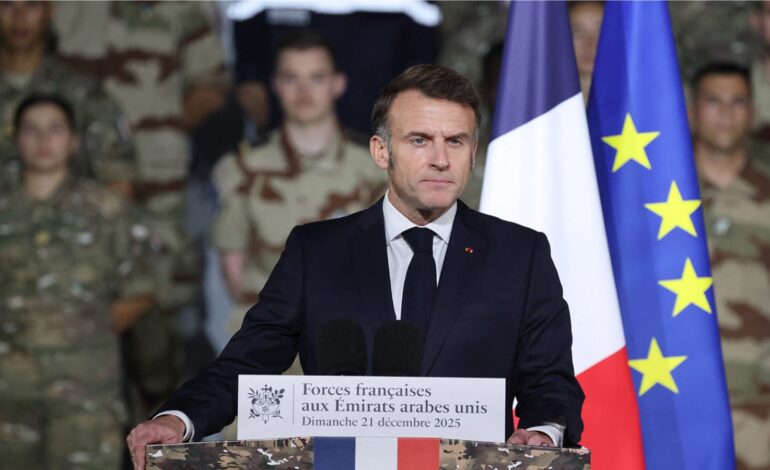

French President Emmanuel Macron has announced plans to build a next-generation aircraft carrier during an official visit to the United Arab Emirates, highlighting the deepening strategic partnership between Paris and Abu Dhabi and France’s determination to strengthen its naval power.
Macron made the announcement while visiting French troops stationed in the UAE, linking the project directly to France’s global defence posture and its long-term military presence in the Gulf. The new carrier will replace France’s current flagship, the Charles de Gaulle, and forms a central pillar of France’s latest defence investment strategy amid changing global security conditions.
The vessel, known as the Porte-Avions Nouvelle Génération (PA-NG), will cost between €10 billion and €12 billion and is expected to enter service in 2038. Once operational, it will serve the French Navy for several decades.
This article explains what the project involves, why it matters for France and the UAE, how it fits into global naval strategy, and what it could mean for defence cooperation and industry.
What Macron Announced in the UAE
During his visit to French forces in the UAE, Macron unveiled plans for a new aircraft carrier to succeed the Charles de Gaulle, which entered service in 2001. The project forms part of France’s defence programming law and aims to preserve the country’s ability to project power at sea and protect strategic interests worldwide.
The PA-NG will exceed its predecessor in size, capability, and technological sophistication. It will integrate advanced propulsion systems, modern combat architecture, and next-generation aviation infrastructure. France plans to commission the carrier around 2038, aligning with the retirement of the existing vessel.
France has already begun work on nuclear propulsion technologies. Macron’s announcement confirms full political commitment and budgetary backing, making the PA-NG one of the most ambitious defence programmes in modern French history.
Why This Aircraft Carrier Matters
Strategic Defence Capability
Aircraft carriers allow France to deploy air power far beyond its borders without relying on foreign bases. The Charles de Gaulle has supported missions across Africa, the Middle East, and NATO operations. Its successor will ensure France retains one of Europe’s few independent blue-water power-projection capabilities.
Technological and Industrial Impact
The programme will mobilise thousands of engineers, technicians, and defence specialists. Hundreds of companies across France, including small and medium-sized enterprises, will contribute specialised systems and components. Macron has repeatedly highlighted the project’s role in strengthening France’s industrial and technological base.
Defence Partnerships and Innovation
Macron’s decision to unveil the programme in the UAE underlines the strategic weight of bilateral defence ties. The UAE already operates French-made military systems, including Rafale fighter jets and Leclerc tanks. The visit created space for broader discussions on defence cooperation, innovation, and joint training.
Technical Features of the New Carrier
According to defence planning documents, the PA-NG will include:
Nuclear propulsion
Advanced nuclear reactors will allow extended deployments without refuelling, giving France greater operational reach.
Increased size and displacement
The carrier will measure roughly 310 metres in length and displace between 78,000 and 80,000 tonnes — nearly double the size of the Charles de Gaulle.
Aircraft and drones
The vessel will operate up to 30 Rafale Marine fighter jets, airborne early-warning aircraft, and unmanned aerial systems.
Modern launch systems
Electromagnetic aircraft launch systems (EMALS) will enable smoother, more flexible aircraft operations.
Together, these capabilities will place the PA-NG among the most advanced aircraft carriers in Europe.
Global Naval Context
Aircraft carriers remain central to modern naval strategy. The United States operates the world’s largest carrier fleet, while China and the United Kingdom continue to expand their capabilities.
By committing to the PA-NG, France reinforces its status as a leading maritime power. In an era marked by tensions in Europe, the Middle East, and the Indo-Pacific, many nations are investing in blue-water navies capable of sustained global operations.
Economic and Industrial Benefits
Boost to domestic industry
The programme will generate long-term economic activity across France’s defence sector. It will preserve high-value engineering skills and support advanced manufacturing.
Stronger export position
Technological advances developed for the PA-NG could enhance France’s competitiveness in global defence markets and open new opportunities for collaboration with allied nations.
Implications for UAE–France Relations
Macron’s announcement during his UAE visit signals the depth of bilateral trust. France maintains a permanent military presence at Camp de la Paix in Abu Dhabi and continues close defence coordination with Emirati leadership.
During the visit, Macron held talks with Mohamed bin Zayed Al Nahyan on regional security, defence cooperation, and strategic stability. The carrier announcement reinforced France’s long-term engagement in the Gulf.
Potential Criticisms and Challenges
Despite its strategic importance, the project faces debate.
Cost pressures
With an estimated price tag of up to €12 billion, critics question whether France should prioritise such spending amid domestic fiscal demands.
Long timelines
Carrier construction demands sustained political and industrial commitment over more than a decade.
Strategic debates
Some analysts argue that unmanned systems may reshape naval warfare. Supporters counter that aircraft carriers offer unmatched flexibility for deterrence, crisis response, and humanitarian operations.
What Comes Next
Following Macron’s announcement, France will move into detailed design, contracting, and construction phases. Major shipyards will begin structural work in the coming years, with assembly and trials planned for the 2030s ahead of final commissioning.
Conclusion
President Emmanuel Macron’s decision to unveil France’s next-generation aircraft carrier during his UAE visit marks a defining moment in French defence policy. The €10–12 billion PA-NG programme reinforces France’s maritime power, strengthens its defence industry, and deepens strategic ties with key partners such as the UAE. As global security challenges evolve, the project positions France to remain a leading naval force for decades to come.