Qatar’s Emir Arrives in Riyadh for Gulf Council Meet
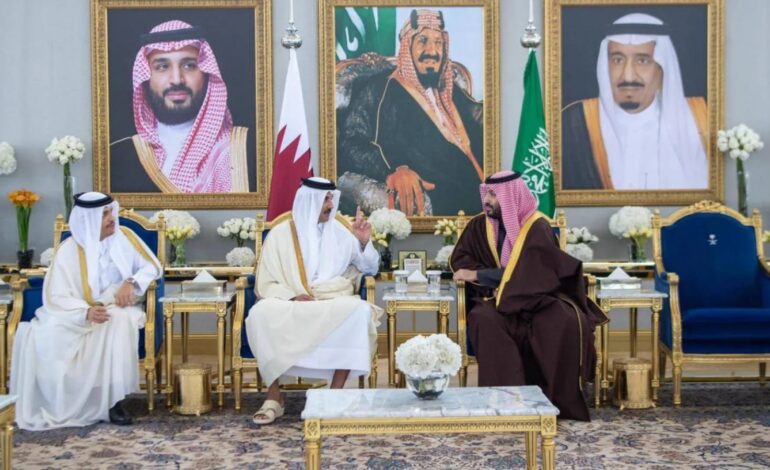

On 8 December 2025, Qatar’s Emir, Sheikh Tamim bin Hamad Al Thani, landed in Riyadh to co-chair the eighth meeting of the Qatari-Saudi Coordination Council. The arrival was met with formal reception by Mohammed bin Salman (MBS) — Crown Prince and Prime Minister of the Kingdom of Saudi Arabia — at King Khalid International Airport.
The two leaders will preside over a high-level session aimed at strengthening bilateral cooperation across political, economic, security, cultural, and developmental domains. The meeting comes against a background of increasing Gulf unity, post-blockade reconciliation, and a shared ambition to deepen integration under regional and global headwinds.
This article outlines what is at stake for both nations, what past coordination efforts have achieved, what new developments could arise from the meeting, and why it matters for the wider Gulf region.
Background — From Discord to Coordination: The Evolution of Qatar–Saudi Relations
Just a few years ago, Gulf geopolitics was defined by a deep rift: a blockade of Qatar by several of its neighbors including Saudi Arabia. That period, which lasted from 2017 to 2021, disrupted diplomatic ties, economic links and the overall unity of the Gulf. However — following reconciliation efforts — the landscape has changed dramatically.
The Qatari-Saudi Coordination Council, originally established in July 2008 in Jeddah, was designed as a permanent institutional mechanism to deepen cooperation between the two states across multiple sectors: politics, trade, security, energy, culture, education and beyond.
Since the reconciliation, this council has gained new momentum. The recent meeting of the Council’s Executive Committee in Riyadh — held on 4 December 2025 — reviewed work by sub-committees covering economic, security, cultural and diplomatic cooperation, and signed minutes formalizing the progress so far.
With the Emir’s arrival to chair the full Council meeting, Doha and Riyadh seem ready to transform institutional coordination into concrete joint projects — sending a signal of Gulf solidarity during a turbulent regional period.
What the 2025 Council Meeting Aims to Achieve — Key Themes & Agenda
Economic & Development Cooperation
Both nations have expressed interest in boosting cross-border investment, infrastructure development, trade facilitation, energy projects, and economic diversification. The 2025 meeting is expected to address frameworks for new large-scale projects, investment protection, and removing trade barriers, especially as both countries push forward their respective national visions.
Saudi Arabia’s ambitious transformation and megaprojects under “Vision 2030” and Qatar’s continuing modernization — especially after its 2022 FIFA World Cup-driven investments — offer complementary strengths. The coordination could see Qatari firms participating in Saudi infrastructure projects, and joint ventures across energy, transport, technology and tourism.
Security & Strategic Cooperation
Given regional volatility — Gulf maritime security, energy security, regional conflicts — Riyadh and Doha see value in aligning on security, intelligence sharing, and defence cooperation. The coordination council offers a formal platform to institutionalize such cooperation, rather than rely solely on informal alliances.
Cultural, Social & Educational Exchange
Deepening people-to-people ties, education exchanges, workforce mobility, and cultural cooperation are also expected on the table. Strengthening social and cultural links can reinforce mutual understanding, diversify cooperation beyond oil/gas, and build resilience in bilateral relations.
Diplomatic Alignment & Regional Coordination
With shifting regional dynamics — conflicts, shifting alliances, global energy transition, geopolitics — coordinated diplomatic posture between Saudi Arabia and Qatar carries weight. The Council meeting could result in joint statements or strategies on regional issues, from energy markets to regional security, Middle East diplomacy, and Gulf cooperation frameworks.
Why This Meeting Matters
1. Consolidating Gulf Reconciliation
The visit and meeting consolidates the thaw that began in 2021, showing that the Gulf rift is no longer a historical footnote — but a closed chapter. A full-scale high-level meeting signals trust, commitment, and a desire to move forward together.
This could encourage other Gulf countries to deepen cooperation in other coordination councils or bilateral frameworks, reinforcing Gulf unity in face of external pressures.
2. Economic Growth & Diversification Gains
With global shifts away from oil dependence, cooperation across diversified sectors — infrastructure, tech, renewables, logistics — offers both countries a chance to build resilient,
diversified economies. Saudi-Qatar coordination could unlock large investments, share expertise and stimulate regional economic integration, which in turn can attract foreign capital and global partners.
Qatari firms’ proven competencies (e.g. from infrastructure built for the World Cup) and Saudi “megaprojects” may find synergy — bolstering construction, transport, hospitality, and services sectors across the GCC.
3. Enhanced Regional Security & Strategic Depth
Joint security cooperation could stabilize Gulf maritime zones, energy transit routes, and deter external interference. The partnership might yield joint military or security initiatives, coordinated foreign-policy stances, and collective defence frameworks better suited to evolving regional threats.
Joint diplomatic stances may also give Gulf countries a more unified voice on global platforms — increasing their influence in international negotiations around energy, security, climate, migration and regional conflicts.
4. Soft Power, Social Integration & Cultural Diplomacy
Cultural, educational, social exchanges can build deeper social cohesion, especially among younger generations. Increased mobility, student exchanges, business exchanges, and shared projects create networks that outlast political cycles — rooting Gulf cooperation at people-to-people level.
This may reduce future tensions, build mutual trust, and make cross-border cooperation more resilient.
Potential Outcomes & What to Watch Post-Meeting
New Bilateral Agreements: Look out for announcements on trade deals, investment frameworks, infrastructure cooperation (e.g. rail, logistics, ports), energy collaboration, technology transfer, and tourism/transport links.
Defense & Security Cooperation: Possible agreements on intelligence sharing, maritime security, coordinated defence planning, and joint security frameworks for the Gulf.
Cultural & Educational Exchanges: Increased scholarships, student-exchange programmes, joint universities or think-tanks, cross-Gulf labour mobility policies, and cultural initiatives.
Regional & Global Diplomacy: A united Gulf stance on crises (Middle East conflicts, energy policy, migration, climate) — giving Saudi–Qatar a stronger regional voice.
Economic Integration & Private Sector Collaboration: Possible influx of Qatari investment into Saudi megaprojects; collaboration in private sector, fintech, infrastructure, tourism, and beyond.
Challenges & What Could Complicate the Vision
Despite optimism, there are challenges:
Historical mistrust and public perception: While elite reconciliation is underway, old memories of discord linger. Ensuring that public sentiment, media narratives and political trust align with the renewed cooperation will require time and sustained outreach.
Divergent national priorities: Saudi Arabia and Qatar have different economic visions, timelines and domestic pressures. Harmonizing them for joint projects — from regulations to execution — can be complex.
Regional instability: Broader Middle-East volatility — conflicts, shifting alliances, global energy market fluctuations — may strain cooperation, especially in sensitive sectors like security, oil & gas, foreign policy.
Economic competition: Both countries may compete for similar foreign investments, energy projects or regional influence. Coordination must avoid domestic clashes or rivalry that undermines trust.
Implementation risk: Institutional coordination is one thing; executing large-scale cooperation — infrastructure, trade, security frameworks — is another. Ensuring transparency, governance, efficiency will be key.
Conclusion
The arrival of Qatar’s Emir in Riyadh for the Saudi-Qatari Coordination Council meeting on 8 December 2025 marks more than a diplomatic visit — it’s a statement of intent. It signals that Gulf unity, reconciliation and strategic cooperation are not just aspirations — they are being institutionalised.
If this meeting yields concrete agreements, joint projects, and a sustained roadmap, it could reshape the trajectory of Gulf geopolitics and economics: deepening integration, boosting shared prosperity, and enhancing regional stability.
For the world watching — from investors to regional stakeholders — the renewed Saudi-Qatar cooperation offers a vision of stability, partnership and long-term commitment. In a region too often defined by conflict and competition, this meeting may signal a different path: one defined by coordination, collaboration and common destiny.