UAE President Meets US Senator Lindsey Graham in Abu Dhabi
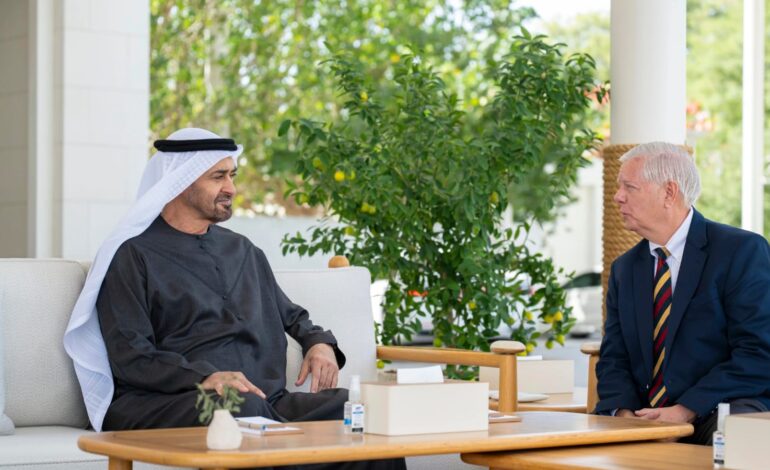

The United Arab Emirates and the United States have reaffirmed their strong strategic partnership following high level talks between UAE President Mohamed bin Zayed Al Nahyan and US Senator Lindsey Graham in Abu Dhabi. The meeting highlights the continued importance both nations place on close coordination across political, economic and security fronts.
Held at a time of heightened regional focus on diplomacy and stability, the engagement underscores the depth of UAE US relations and the shared commitment to advancing mutual interests. Analysts say the visit reflects ongoing efforts by both sides to maintain alignment on key Middle East developments while strengthening long term cooperation.
High Level Meeting at Qasr Al Shati
The discussions took place at Qasr Al Shati in Abu Dhabi, one of the UAE leadership’s primary venues for official meetings. During the talks, the two leaders reviewed bilateral relations and explored ways to further deepen cooperation between their countries.
According to official briefings, the conversation centred on the longstanding friendship between the UAE and the United States. Both sides emphasised their shared commitment to promoting stability, prosperity and constructive international engagement.
Senior Emirati officials and advisers also attended the meeting, highlighting the strategic weight attached to the visit. Their presence reflected the broad scope of the partnership, which spans defence, trade, technology and regional diplomacy.
Focus on a Longstanding Strategic Partnership
During the meeting, Sheikh Mohamed and Senator Graham underscored the strength and durability of the UAE US relationship. Over the past several decades, the partnership has evolved into one of Washington’s most important alliances in the Middle East.
Today, cooperation between the two countries extends across multiple high priority sectors.
Key pillars of the UAE US partnership include
-
Defence and security cooperation
-
Counterterrorism coordination
-
Technology and artificial intelligence collaboration
-
Energy and trade ties
-
Regional diplomatic engagement
Because of this wide scope, regular high level meetings are viewed as essential for maintaining momentum and addressing emerging challenges.
Observers note that the UAE has increasingly positioned itself as a reliable and forward looking partner for the United States in a rapidly changing geopolitical environment.
Regional Security and Peace Efforts on the Agenda
A significant portion of the Abu Dhabi meeting focused on regional developments and ongoing efforts to promote peace across the Middle East. Both sides exchanged views on current security dynamics and the importance of sustained diplomatic coordination.
The discussions come amid continued tensions in several regional theatres, including ongoing conflicts and shifting strategic alignments. As a result, dialogue between close partners such as the UAE and the United States remains particularly important.
Officials familiar with the talks indicated that both leaders reaffirmed their shared interest in supporting de escalation, stability and constructive political solutions across the region.
Given the UAE’s growing diplomatic role and Washington’s longstanding security presence, their coordination is widely viewed as a key factor in regional risk management.
Meeting Draws Global Attention
The meeting attracted additional international attention due to recent online speculation regarding the health of the UAE President. Following the talks, Senator Graham publicly addressed the rumours.
In a statement, he confirmed that he met Sheikh Mohamed for approximately ninety minutes and described the UAE leader as well and sharp. His comments helped dispel the circulating speculation and redirected focus toward the substance of the bilateral engagement.
The release of official photographs from the meeting further reinforced the message of normalcy and continuity in UAE leadership.
Analysts say the episode highlights how closely regional and international audiences monitor high level engagements involving Gulf leaders.
UAE and United States Maintain Robust Ties
The UAE and the United States continue to maintain one of the most comprehensive strategic partnerships in the Middle East. Over the years, the relationship has expanded beyond traditional security cooperation into advanced technology, clean energy and innovation.
Regular diplomatic engagement has played a central role in sustaining this momentum. Meetings between senior officials help both sides align policies, address emerging risks and identify new areas of collaboration.
Areas of active cooperation currently include
-
Joint defence initiatives
-
Intelligence sharing and counterterrorism
-
Artificial intelligence and digital innovation
-
Energy market stability
-
Trade and investment flows
-
Space and advanced technology research
Because the partnership is multidimensional, high level political dialogue remains a critical mechanism for managing its evolution.
Why the Meeting Matters Now
Analysts point to several reasons why the Abu Dhabi talks carry particular significance at this moment.
First, the meeting reinforces continued political alignment between Abu Dhabi and Washington at a time of shifting regional dynamics. Second, it highlights the UAE’s proactive diplomatic engagement with senior US policymakers across both the executive and legislative branches.
Third, the discussions come amid heightened regional security concerns, making coordination between key partners especially valuable. Finally, the visit underscores Abu Dhabi’s growing role as a central diplomatic hub in the Middle East.
Together, these factors explain why the engagement drew close attention from regional observers and international analysts alike.
UAE’s Expanding Diplomatic Role
In recent years, the UAE has increasingly positioned itself as an active diplomatic player across the Middle East and beyond. Abu Dhabi has hosted numerous high level visits and has played roles in mediation efforts, humanitarian initiatives and regional dialogue.
This broader diplomatic strategy complements the country’s economic diversification and technology ambitions. By maintaining strong ties with major global powers, the UAE aims to support both regional stability and its own long term development goals.
Meetings such as the one with Senator Graham form part of this wider diplomatic approach, which emphasises engagement, partnership and strategic balance.
United States Perspective on the Partnership
From Washington’s viewpoint, the UAE remains a key security and economic partner in the Gulf region. The two countries share interests in maritime security, counterterrorism and the protection of global energy flows.
In addition, cooperation in emerging technologies such as artificial intelligence and advanced manufacturing has grown steadily in recent years.
US lawmakers, including Senator Graham, frequently engage with UAE leadership as part of broader congressional interest in Middle East policy and defence cooperation.
Such visits help maintain bipartisan support for the bilateral relationship and provide opportunities to discuss evolving regional challenges.
Economic and Technology Cooperation Growing
Beyond security, the UAE US relationship has expanded significantly in economic and technological domains. Trade between the two countries remains robust, while joint investment initiatives continue to grow.
Particularly notable is the increasing collaboration in artificial intelligence, digital infrastructure and advanced research. The UAE has positioned itself as a regional technology hub, and partnerships with US firms and institutions play a central role in that strategy.
Energy cooperation also remains important, especially as both countries navigate the global transition toward cleaner energy systems.
Because of these overlapping interests, analysts expect the economic dimension of the partnership to deepen further in the coming years.
Looking Ahead to Future Engagement
Although no major policy announcements emerged from the Abu Dhabi meeting, officials indicated that both sides remain committed to expanding cooperation. Future engagement between UAE and US representatives is expected across defence, economic and technological sectors.
Observers anticipate continued high level visits, working group meetings and joint initiatives in the months ahead. As regional dynamics evolve, sustained dialogue between key partners is likely to remain a priority.
The next phase of the relationship may place increasing emphasis on emerging technologies, supply chain resilience and regional de escalation efforts.
Conclusion
President Sheikh Mohamed’s meeting with Senator Lindsey Graham in Abu Dhabi reaffirmed the depth and resilience of UAE US relations. The talks highlighted the shared commitment of both nations to regional stability, economic cooperation and strategic partnership.
At a time of ongoing geopolitical uncertainty, such high level engagements play a vital role in maintaining alignment between close allies. They also signal continuity and confidence in one of the Middle East’s most important bilateral relationships.
Ultimately, the visit underscores a clear message. The partnership between Abu Dhabi and Washington remains strong, forward looking and central to the evolving security and economic landscape of the region.