
UAE President Opens Abu Dhabi Sustainability Week 2026
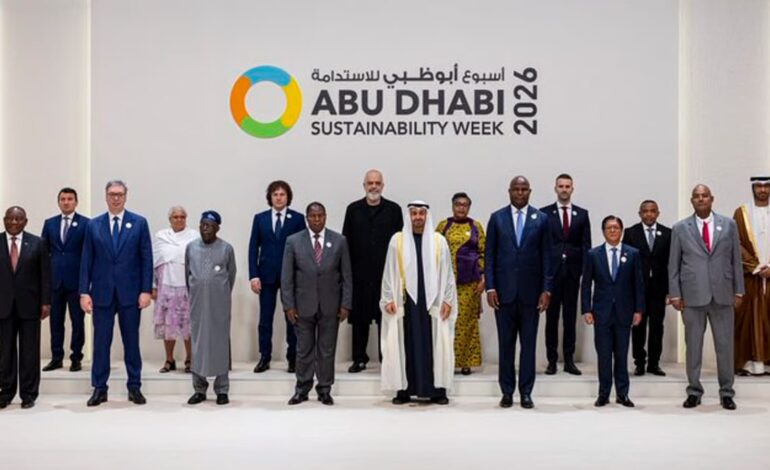

The President of the United Arab Emirates, Sheikh Mohamed bin Zayed Al Nahyan, welcomed world leaders, ministers, global experts, and business figures at the opening of the Abu Dhabi Sustainability Week Summit 2026, reaffirming the UAE’s role as a central platform for international cooperation on climate action, sustainable development, and economic transformation.
Held in the capital, Abu Dhabi, the summit is one of the world’s most influential annual sustainability gatherings. It brings together policymakers, scientists, investors, clean energy pioneers, and civil society leaders to exchange ideas, build partnerships, and advance practical solutions to some of the most urgent environmental and development challenges facing the global community.
A Global Platform for Climate and Development Dialogue
Abu Dhabi Sustainability Week (ADSW) has evolved into a cornerstone of the global sustainability calendar. The 2026 summit continues this legacy by serving as a high-level convening platform where international stakeholders can align priorities, share best practices, and mobilise resources to support climate resilience, clean energy expansion, and inclusive development.
The event underscores the UAE’s commitment to constructive multilateralism, positioning the country as a trusted convenor capable of bridging perspectives between developed and developing nations, governments and the private sector, and innovation and policy.
Opening Ceremony and Presidential Address
At the opening ceremony, Sheikh Mohamed bin Zayed Al Nahyan delivered a keynote address emphasising that global cooperation, innovation, and shared responsibility are essential to confronting climate risks and achieving sustainable development.
He highlighted that climate change is not only an environmental challenge but also a development, economic, and humanitarian issue that requires coordinated action across borders and sectors. The President stressed the importance of accelerating clean energy deployment, scaling sustainable investment, and ensuring that development pathways create opportunities for future generations, particularly youth.
His remarks reinforced the UAE’s belief that collaboration—rather than isolation—is the most effective way to deliver progress on climate action and long-term economic resilience.
Key Themes Shaping Abu Dhabi Sustainability Week 2026
The 2026 summit focused on several interconnected themes that reflect global sustainability priorities and emerging policy debates.
Energy Transition and Clean Power
Energy transition was a central theme, with discussions centred on:
-
Expanding renewable energy capacity
-
Reducing reliance on carbon-intensive fuels
-
Strengthening energy security through diversification
-
Scaling clean energy investment globally
Participants explored pathways for accelerating solar, wind, nuclear, and emerging clean energy technologies, particularly in rapidly growing economies.
Climate Action and Resilience
Climate mitigation and adaptation strategies featured prominently, including:
-
Reducing greenhouse gas emissions
-
Enhancing climate resilience for vulnerable regions
-
Mobilising climate finance for developing countries
-
Strengthening early warning and adaptation systems
These discussions highlighted the need for climate solutions that are equitable, inclusive, and aligned with development goals.
Innovation, Technology, and the Green Economy
The summit showcased the role of innovation in driving sustainability, with sessions on:
-
Hydrogen and next-generation fuels
-
Carbon capture, utilisation, and storage
-
Smart grids and digital energy systems
-
Circular economy and resource efficiency
Technology was presented as a critical enabler of sustainable growth rather than a substitute for policy and governance.
Youth, Education, and Future Skills
Recognising the importance of human capital, ADSW 2026 placed strong emphasis on:
-
Empowering young climate leaders
-
Education for sustainability and green skills
-
Youth participation in climate decision-making
These sessions reinforced the view that long-term sustainability depends on investing in people as much as infrastructure.
Global Participation and High-Level Delegations
The summit attracted high-level delegations from governments across Europe, Asia, Africa, and the Americas, alongside representatives from international organisations, financial institutions, and multinational companies.
This diverse participation enabled:
-
Cross-regional dialogue on policy frameworks
-
Exchange of best practices in sustainability governance
-
Exploration of financing models for large-scale climate projects
The presence of leaders from both advanced and emerging economies reinforced the shared understanding that climate and development challenges are global in nature and require collective solutions.
High-Level Panels, Roundtables, and Special Sessions
Abu Dhabi Sustainability Week Summit 2026 featured an extensive programme of panels, workshops, and roundtables designed to translate dialogue into action.
Key topics included:
-
Sustainable cities and urban mobility
-
Climate finance and blended investment models
-
Green industrial transformation and manufacturing
-
Agricultural innovation and food security
-
Renewable energy roadmaps and grid integration
These sessions fostered practical discussions on implementation, enabling participants to move beyond high-level commitments toward actionable strategies and partnerships.
Strengthening International Cooperation on Climate Finance
One of the summit’s major priorities was climate finance, particularly the mobilisation of capital for mitigation and adaptation projects in developing economies.
Discussions focused on:
-
Unlocking private sector investment
-
De-risking sustainable infrastructure projects
-
Aligning financial systems with climate goals
-
Scaling innovative financing instruments
The UAE’s role as a global financial and investment hub positioned it as a key facilitator in advancing these conversations.
Alignment With UAE Sustainability Strategies
Abu Dhabi Sustainability Week Summit 2026 is closely aligned with the UAE Net Zero by 2050 Strategic Initiative, which aims to achieve net-zero emissions while supporting economic growth and technological innovation.
The summit also supports broader national objectives to:
-
Diversify the economy
-
Attract sustainable investment
-
Promote innovation-led development
-
Strengthen international partnerships
By hosting ADSW, the UAE demonstrates how national climate strategies can be integrated into global dialogue and cooperation.
The UAE’s Role as a Global Sustainability Convenor
The UAE’s ability to bring together diverse stakeholders at Abu Dhabi Sustainability Week reflects its growing influence in global sustainability diplomacy.
The country’s approach is characterised by:
-
Pragmatic solutions over ideological divides
-
Emphasis on implementation and scalability
-
Balanced focus on climate action and development
This positioning allows the UAE to act as a bridge-builder in international climate discussions, particularly between the Global North and Global South.
Implications for Global Climate and Development Agendas
The outcomes of Abu Dhabi Sustainability Week Summit 2026 are expected to inform:
-
Multilateral climate negotiations
-
National sustainability strategies
-
Corporate climate and ESG commitments
-
Investment flows into clean energy and resilience
By fostering partnerships that extend beyond dialogue into tangible projects, the summit contributes to measurable progress toward global sustainability targets.
Looking Ahead: From Dialogue to Action
A defining feature of ADSW 2026 is its emphasis on action-oriented outcomes. Participants repeatedly stressed that ambition must be matched by delivery, investment, and accountability.
The summit sets the stage for:
-
New international collaborations
-
Accelerated deployment of clean technologies
-
Increased alignment between policy, finance, and innovation
This focus ensures that Abu Dhabi Sustainability Week remains not just a forum for discussion, but a catalyst for real-world impact.
Conclusion: Advancing a Shared Vision for a Sustainable Future
The UAE President’s welcoming of global leaders and experts at Abu Dhabi Sustainability Week Summit 2026 reflects the nation’s steadfast commitment to cooperative solutions for climate action and sustainable development.
By convening governments, businesses, investors, and civil society, the summit reinforces the importance of collaboration in addressing complex global challenges. It also strengthens the UAE’s position as a trusted international partner and a leading platform for shaping the future of sustainability.
As climate risks intensify and development needs grow, forums like Abu Dhabi Sustainability Week play a vital role in aligning global efforts toward a more resilient, inclusive, and sustainable future for people and the planet.






4 Comments
[…] In a landmark development for international trade and economic diplomacy, the United Arab Emirates and the Republic of the Philippines have formally signed a Comprehensive Economic Partnership Agreement (CEPA) in Abu Dhabi. The historic agreement was witnessed by Sheikh Mohamed bin Zayed Al Nahyan, President of the UAE, and Ferdinand R Marcos Jr, President of the Philippines, during the Abu Dhabi Sustainability Week Summit 2026. […]
[…] Partnership Agreement (CEPA) in Abu Dhabi. The landmark accord was signed on the sidelines of the Abu Dhabi Sustainability Week Summit 2026, in the presence of Sheikh Mohamed bin Zayed Al Nahyan, President of the UAE, and Bola Ahmed […]
[…] ADSW 2026, youth participation extended far beyond symbolic representation. The Youth for Sustainability Forum and Hub created a space where young people actively engaged with policy frameworks, technology deployment, […]
[…] meeting aligns with the UAE’s broader vision of fostering international partnerships that support sustainable growth, innovation, and stability. By hosting global leaders during Abu Dhabi Sustainability Week, […]
Comments are closed.