
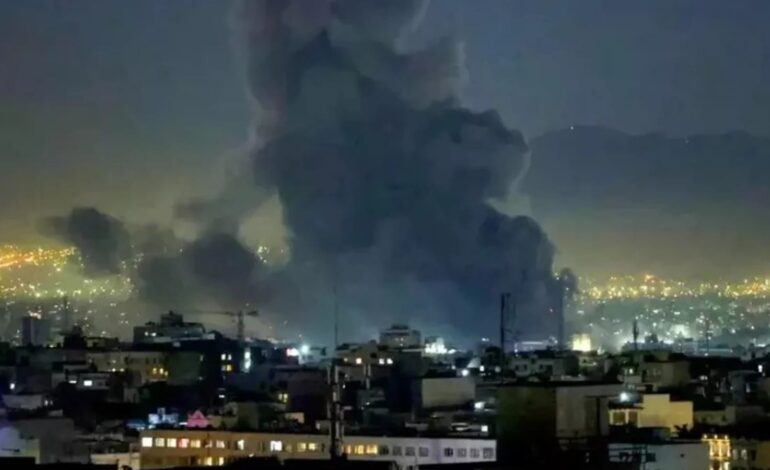

The United States military has confirmed that nearly 2,000 targets across Iran have been struck in a sweeping and sustained military campaign designed to cripple the country’s strategic military infrastructure and weaken the powerful Islamic Revolutionary Guard Corps (IRGC).
The large-scale operation, conducted in coordination with Israel, represents one of the largest sustained strike campaigns in the Middle East in decades. According to officials from the US Central Command (CENTCOM), the strikes targeted a wide network of military assets including missile launch sites, air defence systems, naval installations, logistics hubs and command centres across Iran.
Military leaders say the operations are part of a broader strategy to reduce Iran’s ability to launch missile and drone attacks against US forces and allied countries in the Gulf and the wider Middle East.
The campaign comes amid escalating regional tensions following Iranian retaliatory attacks targeting military bases, infrastructure and cities across several Middle Eastern countries.
Nearly 2,000 Strategic Targets Hit Across Iran
US military officials revealed that the campaign has involved continuous day-and-night strikes, targeting critical elements of Iran’s military capabilities.
According to CENTCOM, the strikes have focused on a wide range of military infrastructure including:
-
Missile launch facilities
-
Air defence systems
-
Military bases
-
Naval facilities
-
Command and control centres
-
Logistics depots
-
Drone production sites
CENTCOM commander Admiral Brad Cooper said the objective of the operation is to neutralise Iran’s ability to launch attacks against US personnel, regional allies and international shipping routes.
The campaign has involved a combination of air strikes, naval operations and long-range precision weapons. Allowing US forces to hit multiple targets simultaneously across different regions of Iran.
Military analysts say the scale of the operation is unprecedented in modern Middle Eastern conflicts. With thousands of strike sorties reportedly carried out over several days.
Experts also note that the coordination between US and Israeli military forces has enabled highly targeted strikes against sensitive military facilities.
Focus on Weakening the Islamic Revolutionary Guard Corps
A central goal of the campaign has been to weaken the Islamic Revolutionary Guard Corps (IRGC), which plays a key role in Iran’s military strategy and regional operations.
The IRGC is one of the most powerful institutions in Iran and controls significant elements of the country’s military capabilities, including missile forces, naval units and overseas proxy networks.
US officials say many of the strikes specifically targeted IRGC-controlled infrastructure and operational centres.
Key targets linked to the IRGC include:
-
Command and control facilities
-
Missile and drone manufacturing plants
-
Military logistics depots
-
Radar installations
-
Air defence systems
According to defence officials, the goal is to disrupt the operational networks that enable Iran to conduct military operations across the Middle East.
The IRGC has long been accused by the US and several regional countries of supporting armed groups and militias across the region, making it a primary focus of the military campaign.
By degrading the IRGC’s capabilities, US military planners aim to limit Iran’s ability to conduct coordinated attacks or project military influence beyond its borders.
Major Damage to Iranian Military Infrastructure
Alongside strikes on land-based targets, Iranian naval and missile capabilities have also been heavily affected.
Reports from military sources indicate that multiple Iranian naval vessels, missile batteries and weapons storage facilities have been destroyed during the operation.
In addition, several air defence systems across Iran have reportedly been severely degraded, reducing the country’s ability to intercept incoming air strikes.
US commanders say the strikes have significantly weakened Iran’s ability to project military power across the Gulf region, particularly in areas near strategic maritime routes.
The destruction of missile launch systems and drone facilities is expected to have a direct impact on Iran’s ability to conduct further attacks against regional targets.
However, analysts caution that Iran still retains a large missile arsenal and could continue retaliatory actions.
Iran Launches Retaliatory Missile and Drone Attacks
Despite the scale of the US-led strike campaign, Iran has responded with large-scale retaliatory attacks across the Middle East.
According to US officials, Iran has launched hundreds of ballistic missiles and thousands of drones targeting US military bases, infrastructure and cities across the region.
Several Gulf countries have reported missile and drone interceptions in recent days.
Targets have reportedly included:
-
The United Arab Emirates
-
Qatar
-
Bahrain
-
Kuwait
Regional air defence systems have intercepted many incoming projectiles, preventing major damage in most cases.
However, falling debris from intercepted missiles has caused damage and injuries in some areas.
In the United Arab Emirates, air defence systems intercepted several projectiles, though debris from destroyed missiles caused damage in parts of Abu Dhabi and Dubai.
Authorities across the region have urged residents to remain calm while relying on official updates from government sources.
Strategic Importance of the Military Campaign
The large-scale strikes against Iranian military targets are part of a broader strategy aimed at protecting regional security and global trade routes.
The Middle East contains some of the world’s most critical shipping lanes, particularly the Strait of Hormuz, through which a significant portion of global oil exports passes.
US officials have long warned that Iran’s missile systems, drones and naval forces pose a potential threat to commercial shipping and energy infrastructure in the region.
By targeting military facilities across Iran, US forces aim to prevent further attacks on shipping routes and maintain stability in international trade.
Ensuring the security of maritime routes is considered essential for global economic stability, as disruptions could have far-reaching consequences for energy markets and supply chains worldwide.
Impact on Global Energy Markets
The escalating conflict has already had a noticeable impact on global energy markets, particularly oil prices.
Investors and governments around the world are closely monitoring developments in the Gulf amid concerns that instability could disrupt oil exports from major energy producers.
The Strait of Hormuz remains a key focal point of concern, as roughly one-fifth of global oil supply passes through the narrow waterway.
Any disruption to shipping traffic in this region could significantly affect global energy markets.
In response to the rising security risks, several shipping companies have increased safety measures, while insurance costs for vessels travelling through the region have risen sharply.
Financial markets have also shown increased volatility as geopolitical tensions continue to escalate.
Energy analysts warn that prolonged conflict could push oil prices higher and create uncertainty in global supply chains.
Heightened Security Across the Middle East
Countries across the Middle East have responded to the escalating conflict by strengthening security measures and increasing military readiness.
Several Gulf states have activated emergency response systems and heightened air defence operations.
Key steps taken by regional governments include:
-
Increasing air defence readiness
-
Strengthening protection around oil facilities
-
Enhancing security at airports and seaports
-
Expanding surveillance and early warning systems
Countries including the United Arab Emirates, Saudi Arabia and Qatar have reported successful missile interceptions and elevated defence alerts in recent days.
Regional leaders have emphasised the importance of maintaining public calm while ensuring the protection of critical infrastructure.
Authorities have also urged residents to rely on verified information and avoid spreading rumours during the crisis.
Growing Humanitarian Concerns
As the conflict continues to escalate, humanitarian organisations are warning about the potential impact on civilian populations across the region.
Large-scale military strikes and missile attacks have already caused casualties and infrastructure damage in several countries.
Aid groups fear that continued escalation could lead to:
-
Population displacement
-
Shortages of food and essential supplies
-
Damage to critical infrastructure
-
Disruptions to healthcare services
Humanitarian agencies are calling for increased international coordination to protect civilians and deliver aid to affected areas.
The United Nations has also expressed concern over the growing crisis and has urged all parties to exercise restraint.
UN officials have called for renewed diplomatic efforts to prevent the situation from deteriorating further.
International Diplomatic Efforts Intensify
The rapidly evolving conflict has triggered urgent diplomatic discussions among global powers.
Several governments have called for negotiations aimed at reducing tensions and preventing the war from expanding further across the Middle East.
However, deep political divisions remain over how the crisis should be resolved.
Some countries support the military campaign against Iran, while others are urging an immediate ceasefire and diplomatic engagement.
Diplomatic talks are expected to intensify in the coming days as world leaders attempt to prevent further escalation.
International organisations and mediators are also working to facilitate communication between the parties involved.
What Happens Next
Military analysts say the coming days will be critical in determining the trajectory of the conflict.
Several possible scenarios are currently being closely monitored:
-
Continued large-scale military strikes against Iranian targets
-
Expanded Iranian retaliation across the region
-
Greater involvement from international allies
-
Diplomatic negotiations aimed at de-escalation
Given the scale of the current operations, experts warn that the conflict could become one of the most significant geopolitical crises in the Middle East in recent history.
The situation remains highly fluid, with developments unfolding rapidly across multiple countries.
The confirmation that nearly 2,000 targets in Iran have been struck by US forces highlights the scale and intensity of the ongoing conflict between Iran and its adversaries.
The campaign has significantly damaged Iranian military infrastructure, particularly facilities linked to the Islamic Revolutionary Guard Corps and the country’s missile and drone programmes.
However, Iran’s retaliatory attacks and the rising geopolitical tensions across the region show that the conflict is far from over.
With regional security, global energy markets and international diplomacy all at stake, the coming weeks will be crucial in determining whether the crisis escalates further or moves toward a diplomatic resolution.
As the situation continues to develop, governments and global institutions are closely monitoring events in what could become a defining moment for the future of security in the Middle East.




2 Comments
[…] its official statement, the Arab Interior Ministers Council said the Iranian strikes targeted several Arab nations, including United Arab Emirates, Bahrain, Saudi Arabia, Kuwait, […]
[…] CENTCOM reported that more than 50 Iranian naval vessels have been damaged or destroyed during the conflict. […]
Comments are closed.